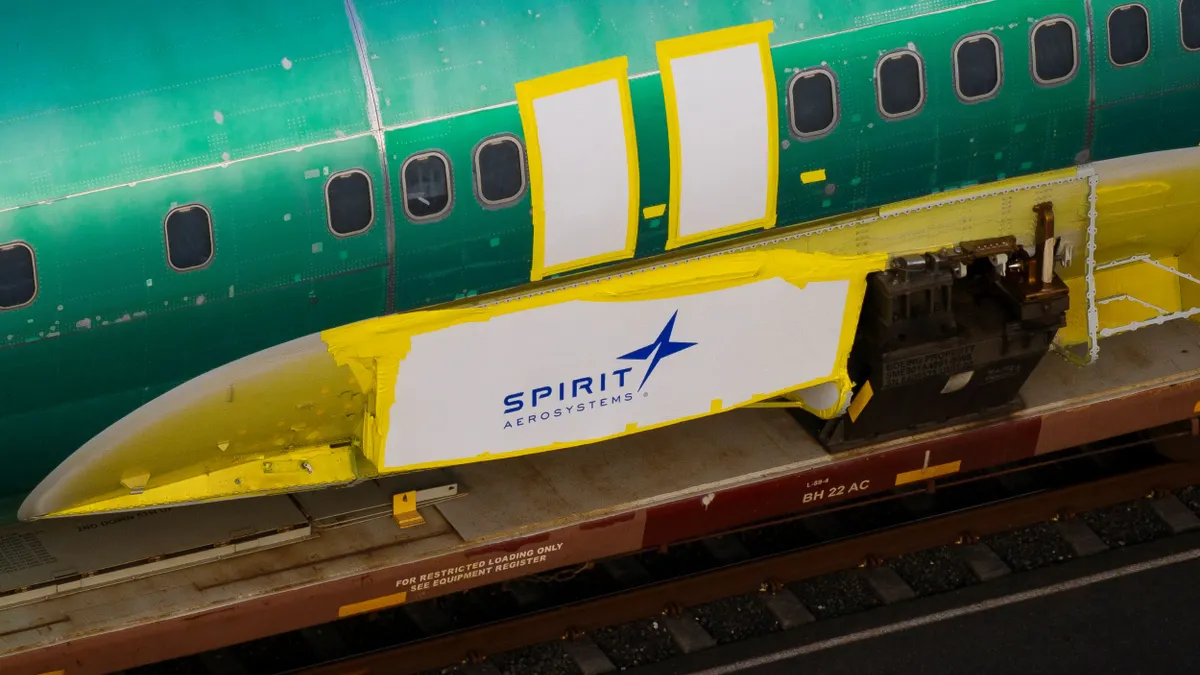
Feb. 18, 2026: The Federal Trade Commission announced on Tuesday that it has finalized a consent order involving Boeing’s acquisition of Spirit AeroSystems.
The decree resolves the agency’s allegations that the plane manufacturer’s acquisition of the fuselage supplier would enable Boeing to raise costs or harm competitor Airbus’ access to inputs for its commercial aircraft.
The order also resolves FTC’s allegations that Boeing could limit rival military aircraft companies’ access to Spirit AeroSystems’ aerostructure products and technologies.
Dive Brief:
- Dec. 4, 2025: The Federal Trade Commission announced on Wednesday that it approved Boeing’s plan to acquire Spirit AeroSystems but the plane manufacturer must adhere to certain antitrust requirements before completing the deal.
- The agency ordered the plane manufacturer to divest Spirit AeroSystems’ segments that supply components to Airbus and Composites Technology Research Malaysia, which are pending.
- Additionally, the FTC mandated that Boeing and Spirit AeroSystems continue supplying aerostructures and services to competing defense contractors for their military aircraft programs, according to the agency’s press release.
Dive Insight:
Boeing initially reached an agreement to acquire Spirit AeroSystems in July 2024. The all-stock deal is valued at $4.7 billion, with Boeing also taking on the fuselage supplier’s roughly $4 billion debt, for a total value of $8.3 billion.
A Boeing spokesperson said in an email to Manufacturing Dive that it welcomes the agency’s approval of its Spirit AeroSystems acquisition
“While the transaction has not yet fully closed, we are committed to completing the remaining steps necessary to finalize the acquisition,” the Boeing spokesperson said in a statement. “This milestone will further enhance our ability to manufacture safe, high-quality airplanes for our customers and benefit the flying public.”
The FTC gave other remedies for the merger, including requiring Boeing to provide transactional services to Airbus and CTRM to assist the companies in manufacturing various products. Furthermore, the agency appointed Berlin-based consulting firm ALCIS Advisers as the monitor to oversee and report on Boeing and Spirit AeroSystems’ compliance, according to the decision.
Moreover, Spirit AeroSystems will be required to continue its existing agreements with other defense contractors and remain available as a supplier for future competitors, according to the news release. In addition to Boeing’s P-8, C-40 and KC-46 military aircraft, Spirit AeroSystems designs, engineers and manufactures structural components for Lockheed Martin and Sikorsky’s CH-53K helicopter, Bell’s V-280 helicopter, and the Northrop Grumman B-21 bomber jet, according to the supplier’s website.
The FTC has ordered the Department of Defense’s undersecretary for acquisition and sustainment to appoint a compliance officer to oversee the implementation of the terms, per the decision document. The DOD official will have the authority to investigate any issues or complaints brought to them.
The FTC has issued an administrative complaint against Boeing and Spirit AeroSystems, alleging that the companies would be violating antitrust laws if the merger is completed before addressing the agency’s concerns. The agency said the merger would give Boeing the ability and incentive to deny or limit competitors’ access to Spirit AeroSystems’ aerostructure products and technologies. Boeing could also gain access to its competitors’ sensitive intellectual property and exploit the information for its own advantage, the FTC alleged.
“American commercial travelers and our military deserve to fly on dependable aircraft, manufactured with reliable components,” David Shaw, principal deputy director of the FTC’s Bureau of Competition, said in a statement. “The Trump-Vance FTC’s action today protects aircraft manufacturing competition to ensure that Americans across the country can continue to access high-quality aircraft to reach their next destination.”
The FTC will open a 30-day comment period, during which the public can submit remarks on the agency’s proposed consent agreement package and will be posted on the Register website. Boeing expects to complete the Spirit AeroSystems acquisition later this year.