Deere & Co. on Wednesday reported a 15% sales decline to $4 billion in its production and precision business, which accounts for tractors and other large agricultural equipment, during its fiscal fourth quarter compared to last year.
This pushed overall earnings downward during the three months that ended Nov. 1. This was partially offset by growth in Deere’s construction and small agricultural equipment segments.
The John Deere tractor maker’s largest business segment attributed sales and profit declines to lower shipment volumes during the period. It saw an operating profit of $406 million, down 33% over last year.
Market conditions varied by segment as farmers worked through tight margins, rising input costs and volatile commodity markets, which adversely affected buying patterns, Deere CEO John May said in an earnings call Wednesday morning.
At the same time, construction markets are getting stronger, in part due to a boom in data center projects, May said. He added that small agriculture and turf sales were supported by dairy and livestock markets.
“Through it all, our teams kept inventories healthy, stayed focused on the investments that mattered most for our customers and delivered double-digit margins in every segment,” he said on the call. “For me, that’s what matters most about this year.”
The construction and forestry segment saw sales increase 12% to $3.8 billion during the quarter compared to last year, driven by higher shipment volumes and favorable pricing. Its operating profit dipped 3% to $339 million.
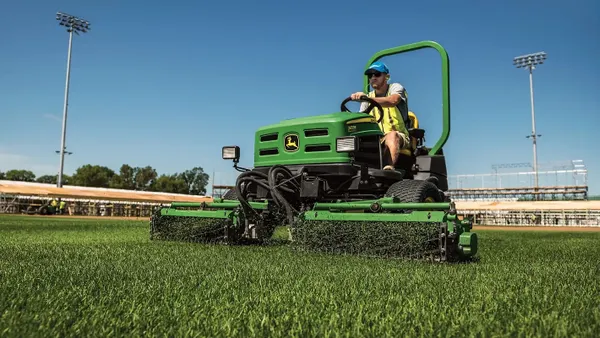
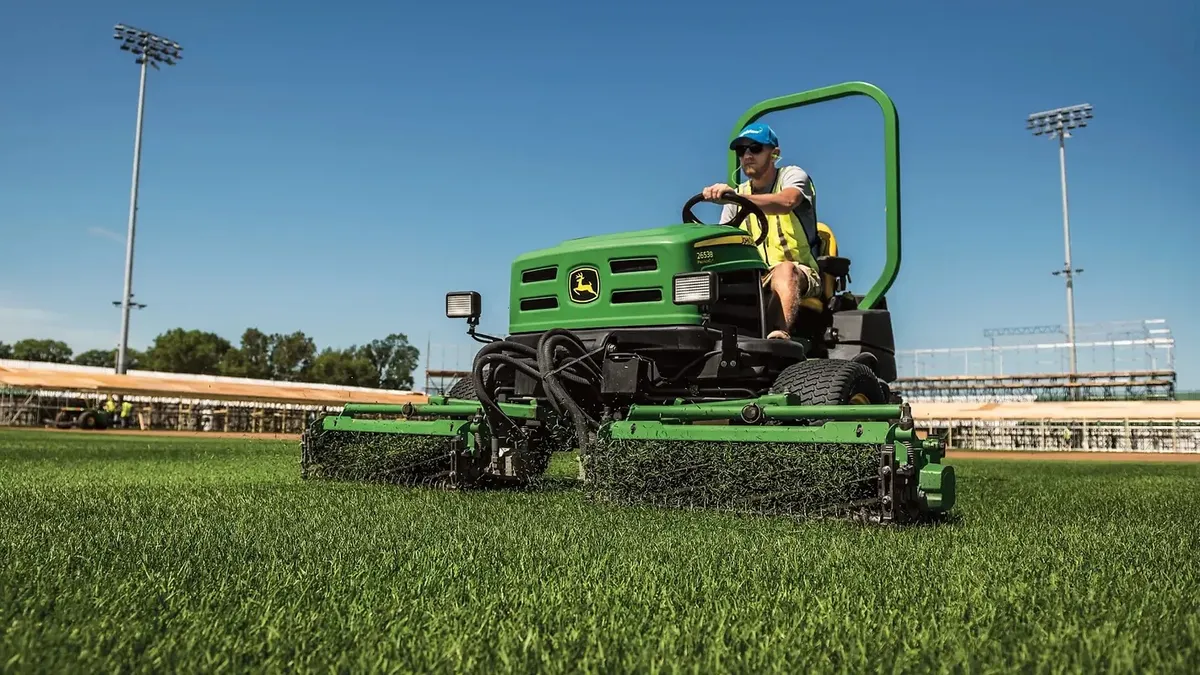
Over the same period, Deere’s small agriculture and turf segment saw sales increase 10% to $2.7 billion and saw operating profit surge 832% to $233 million.
Looking ahead, the company is expecting a turnaround for its large agricultural equipment segment led by the North American market. Even as farm economics remain tight amid crop inflation, May said strong demand to replace an aging fleet is driving sales upward. He also said that Deere would keep a close eye on construction development over the next year or two after communities voted to ban data centers in the midterm elections.
Over the 12 months that ended in Nov. 1, Deere reported net sales and revenue of $47.7 billion, up 4% over the previous period. The company made $4.9 billion in net income, down 3% from a year ago.
Employee reshuffling
Over the past month, Deere moved to restructure its factory workforce and operations ahead of future labor contract negotiations.
In late October, the company said it would hire more than 400 workers at its Illinois, Iowa and Kansas facilities, and call back more than 275 employees to its Waterloo, Iowa, operations.
Shortly thereafter, Deere disclosed plans to shuffle production to different locations, including moving windrower and round baler operations in Iowa from Ottumwa Works to Des Moines Works by the end of fiscal year 2027 and fiscal year 2028, respectively.
The company also plans to move its Hagie single-tank system sprayer production from Clarion, Iowa, to a factory in Thibodaux, Louisiana, beginning in fiscal year 2028.
As a result of those changes, Deere said it will close its Ottumwa Works factory once the windrower and round baler transitions are completed, and cease production in Clarion by fiscal year 2029.
The company did not disclose how many workers would lose their jobs due to the two plant closures. The closures are expected to affect 400 workers at Ottumwa and 300 at Hagie, according to Michigan Farm News, an official publication of Michigan Farm Bureau.
The United Autoworkers union said it was “disgusted” by Deere’s decision and would use every tool available to keep jobs in Iowa.
Orchard AI
Last week, Deere expanded its smart farming business with the acquisition of Orchard Robotics, a San Francisco-based startup that allows farmers to glean insights from crop data captured via artificial intelligence-powered cameras mounted on their tractors.
The company, which operates under the name Orchard AI, developed software that combs through hundreds of images of trees, vines and plants, offering growers a detailed view of their crop conditions as well as yield estimates and fruit size, color and canopy data.
The deal combines Orchard AI with Deere’s growing expertise in precision agriculture, equipment and farm technology, the company said in a news release.
No financial terms were disclosed. Last year, Deere acquired a maker of autonomous orchard and vineyard sprayers, Guss Automation, and drone imagery company Sentera to enhance its smart farming capabilities.
Full-year outlook
Deere forecasted its production and precision agriculture sales to recover next year, rising 5% to 15%. Over the same 12-month period, it estimated that small agriculture and turf would be flat compared to last year and construction, and forestry could be flat or up 10%.
Deere forecasted its full-year net income to be in the range of $4.5 to $5.25 billion.
May said Deere’s guidance reflects a wide range of outcomes due to uncertainty in key markets. “Even so, we’re well positioned to capture the opportunities ahead,” he said.