Dive Brief:
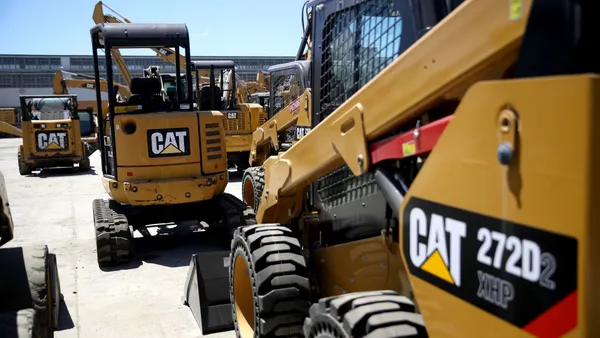
- Caterpillar reported record high sales and revenue of $19.1 billion during the fourth quarter, driven by strong demand for construction, mining and power equipment as tariff uncertainty affected manufacturing costs.
- The Irving, Texas-based company saw double-digit sales growth across its three primary segments during the period. Operating profit, however, was $2.7 billion, a 9% decline over last year. Higher tariff and restructuring costs were partially offset by turbine and engine orders from oil and gas and data center customers.
- Caterpillar recently agreed to supply two-gigawatt generators for American Intelligence and Power Corp’s multibillion-dollar data center development in Mason County, West Virginia. Excluding this deal, the company’s order backlog reached a record high $51 billion at the end of the year.
Dive Insight:
“With a record backlog, we enter the new year with strong momentum and a continued focus on delivering long-term value for our customers and shareholders,” Caterpillar CEO Joe Creed said on an earnings call Thursday.
During the quarter, the largest sales increase came from the company’s power and energy segment, formerly known as transportation and energy, followed by construction and mining. Power and energy sales grew to $9.4 billion, up 23% over the previous year. Operating profit was $1.8 billion, up 25% from a year ago.
“We're one of the fastest solutions out there for data centers who are trying to get up and running quickly,” Creed said. The company is talking with hyperscalers and large data center customers on a weekly basis to ensure it’s aligned with their project plans, he said.
Construction and mining equipment sales also increased during the period over the previous year. However, segment profits fell short due to “unfavorable” tariff costs and prices. Caterpillar reported a nearly $1 billion impact on manufacturing and $282 million linked to higher restructuring costs.
For the full year, Caterpillar reported sales and revenue of $67.6 billion, up 4% from 2024. The increase came, in part, from record sales in the company’s power and energy segment. Power generation sales alone surpassed $10 billion in 2025, Creed said. Meanwhile, operating profit was $11.2 billion, down 15% from the previous year.
Tariff volatility raised manufacturing costs and hurt profitability throughout 2025. Caterpillar worked to mitigate tariffs in the form of cost controls and pricing actions, resulting in a net incremental headwind of $1.7 billion for the year, Creed said.
Looking ahead, Caterpillar expects full-year 2026 sales and revenue growth between 5% to 7% over the previous year, according to its presentation slides. The company is also bracing for incremental tariff costs of $2.6 billion and restructuring costs between $300 million and $350 million.
Wall Street analysts came away positive from the report. While tariffs are “keeping a lid” on margins, Caterpillar seems to be conservative about 2026 and the strong backlog creates some upside for 2027, Michael Feniger, a research analyst at Bank of America, said in a brief. He also noted that power and energy is in a “sweet spot” as Caterpillar looks to recover the machinery side of the business.
Caterpillar is also making a leadership change. Tony Fassino, president of the construction segment, will retire at the end of May after 30 years with the company, according to a news release. Rod Shurman, who has been with Caterpillar since 1997, is scheduled to take over the position effective Feb. 1.
With exception to Caterpillar’s roaring power and energy business, Creed said orders within its construction and mining segments can be inconsistent or “lumpy.”
“We're happy to see the orders that came in,” he said. “I don't know that you can count on repeat every quarter of that.”