Dive Brief:
- Blue Origin is investing $600 million to expand its Rocket Park manufacturing campus in Cape Canaveral, Florida, Gov. Ron DeSantis announced May 22.
- The Jeff Bezos-founded aerospace company plans to build an upper-stage facility spanning about 830,000 square feet that would increase the volume and mass “that can be delivered to orbit from Florida,” according to the press release.
- The investment, dubbed Project Horizon, will also create 500 jobs with an average salary of over $98,000. No other details were disclosed and Blue Origin did not respond to requests for comment.
Dive Insight:
Blue Origin’s manufacturing and operations footprint in Florida involves 11 sites across Brevard and Orange counties, including Merritt Island, Cape Canaveral, Titusville, Melbourne and Orlando, representing more than $3 billion in facilities and infrastructure, according to a September 2025 press release.
Blue Origin, established in 2000, employs nearly 4,000 people in Brevard County and has spent more than $2.3 billion with 500 suppliers in the state.
“Our expansion in Florida is driven by increased customer demand and the growth of our efforts with NASA to return humans to the Moon,” the company said in the September release. “We’re rapidly scaling our lunar program to ensure NASA has the hardware necessary for landing cargo and crew on the Moon and Mars.”
Blue Origin’s facilities include a manufacturing site for its Blue Moon Mark-2 Lunar Lander and Transporter, which are being developed for NASA’s human landing system program.
The company had also planned to complete construction of a chemical processing facility and expand its main assembly building to accommodate two more automated fiber placement machines for the New Glenn’s payload fairing and adapter production.
Blue Origin will use Florida’s Spaceport Improvement Program, a state incentive under its Transportation Department. The SIP aims to draw in private capital and accelerate development in the state.
The space program also focuses on improving aerospace transportation facilities and assisting interagency efforts to improve space transportation capacity and efficiency, according to the Space Florida website.
As of May 2026, the SIP has funded 48 major infrastructure projects using over $531 million in state investment to attract $3.3 billion to Florida’s spaceport system, according to the press release.
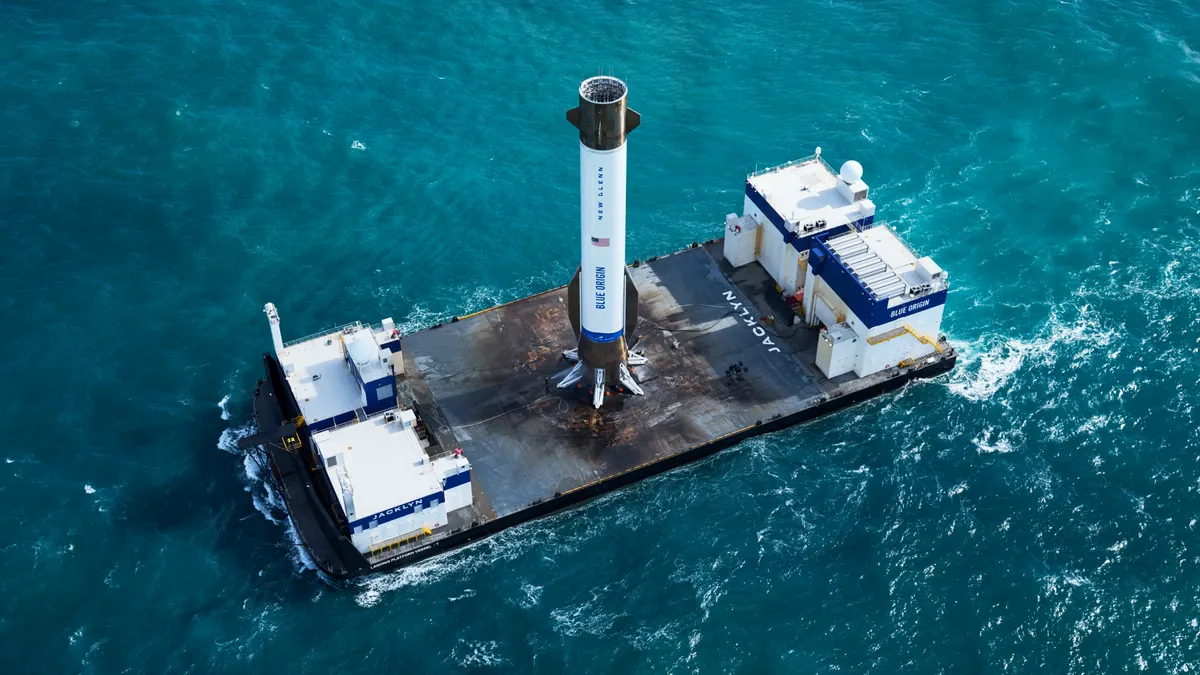
Blue Origin has used the SIP on a previous project to build a new pad at Launch Complex 36 at Cape Canaveral Space Force Station, located nine miles from its rocket factory, according to the aerospace company’s website. The company invested over $1 billion to rebuild the launch site and completed construction in 2021. LC-36 is also home to the New Glenn’s launch pad, vehicle integration, first stage refurbishment, propellant facilities and environmental control center.
Other aerospace companies that previously or currently use the SIP include Boeing for its Starliner assembly, Airbus’ U.S. space and defense satellite facility, SpaceX’s new processing and Starship manufacturing facility and BAE Systems’ Pearlson Shiplift and land-level repair complex.
Blue Origin’s latest expansion announcement follows the Federal Aviation Administration’s closing of its investigation into the company’s New Glenn rocket “mishap” that occurred on April 19.
The incident happened during the rocket’s second-stage flight sequence, and the FAA ordered Blue Origin to conduct an investigation, which the agency oversaw.
The FAA approved Blue Origin’s report that found a cryogenic leak in the New Glenn rocket. This froze the hydraulic line and caused a thrust anomaly amid its second-stage engine burn.
The company also identified nine corrective actions that would prevent the mishap from happening again, the FAA said. The rocket is authorized to return to flight, provided that Blue Origin implements the corrective actions before the New Glenn’s next mission.