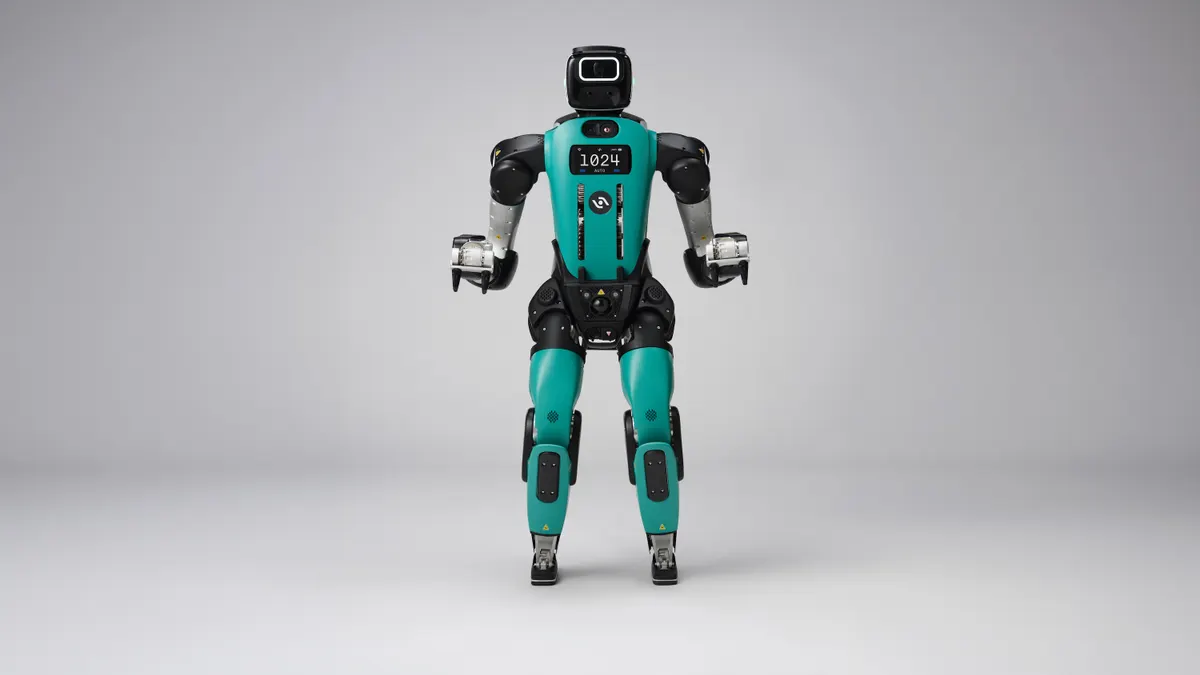
Agility Robotics has introduced its latest autonomous humanoid, Digit 5, with a focus on working safely alongside people.
The Salem, Oregon-based company marketed the robot as “the first cooperatively safe humanoid,” capable of doing tasks in proximity to people in industrial settings outside of safety cages and work cells.
What that looks like in practice, according to a promotional video, is a robot that stops what it is doing and crouches into a ball when a human is nearby.
“The goal of all of this is to get to collaborative safety,” Kevin Reese, senior director of robotics safety at Agility, said in the video.
Cooperative safety, for example, is when a robot sets something down and a person comes along later to pick it up. Collaborative, Reese said, is when someone hands an object to the robot and it does a new task.
“As humanoids get more capabilities and more experience out in the real world, they’re going to have to go through gradual progressions,” he said.
Agility on its website said that Digit 5 is still in development, and the product’s features, specifications, capabilities and designs are subject to change. However, safety is still the main objective.
As advancements in artificial intelligence have expanded what humanoids and other robotics are capable of doing, Agility said widespread adoption of autonomous robots is limited by how safe they can operate alongside people.
“We believe safety cannot be added to a humanoid robot as a standalone feature — it must be designed into every aspect of the system from the outset,” the company said in a securities filing.
In addition to enhanced safety features, the robot can work 20 hours out of a 24-hour shift, has a seven-foot reach, can carry objects weighing up to 50 pounds and has a 10-to-1, run-to-charge ratio, according to Agility’s website. It is designed to automate tasks such as tote handling, machine tending and palletizing, as well as kitting and sequencing.
Earlier this month, the company disclosed in a securities filing that it has one customer with plans to spend $300 million on Digit 5 over multiple years. It also has a growing pipeline of more than 30 prospective customers.
In June, Agility announced plans to go public through a $2.5 billion merger with Churchill Capital Corp., in part, to scale production of Digit 5. The merger is pending and expected to close sometime this year.
Universal Robots
Universal Robots, a Denmark-based maker of collaborative industrial robots, debuted its seventh-generation robotics platform last week at the International Manufacturing Technology Show in Chicago.
The platform, Gen 7, is a system upgrade featuring a PolyScope X operating system and AI-ready capabilities. It has a reengineered control box, teach pendant and tool flange, which the company said makes tasks and setups easier compared to previous versions.
“Gen 7 is an end-to-end redesign of our platform that reduces integration friction and dramatically expands application capabilities,” Jean-Pierre Hathout, president of Universal Robots’ parent company Teradyne Robotics Group, said in a statement. “It will enable our customers and partners across industries to confidently deploy advanced AI-powered applications in real-world operations.”
The Gen 7 platform added three new g-Series robot arms and a tool flange that enables vision and sensing for AI models to run in real time with the robot. It also has a smaller controller and lighter teach pendant compared to previous versions.
Additionally, the new tool flange allows operators to program the robot with a “touch-to-teach” feature that cuts out setup and programming time.
Fanuc America
Fanuc America also showcased several new products at IMTS.
The Rochester Hill, Michigan-based company introduced its portable CRX-3iA industrial arm, which has a nearly 7-pound payload and lightweight design.
The robot can be carried with one hand and installed in tight spaces, making it ideal for shipbuilding, welding and assembly, according to Fanuc’s website.
Additionally, the company debuted its R-50iA compact controller, which is designed for collaborative arms mounted on autonomous mobile robots.
The controller supports up to 48 volts of battery power and eliminates the need for a separate inverter, simplifying mobile robot integration, according to a news release. It also has cybersecurity and advanced vision capabilities.
Fanuc is also collaborating with Google Cloud to advance physical AI technologies, combining its robotics with the Gemini Enterprise.