
A production plant sensor reading vibration off a turbine has to decide, in something close to real time, whether the machine keeps spinning or shuts down. Route that decision to a cloud service and back, and the extra latency can mean the difference between a controlled stop and expensive equipment damage. That is the simplest version of a shift now reworking industrial silicon: the AI models that used to live in a data center are moving into the equipment itself, because the equipment cannot afford to wait for cloud-based decisions.
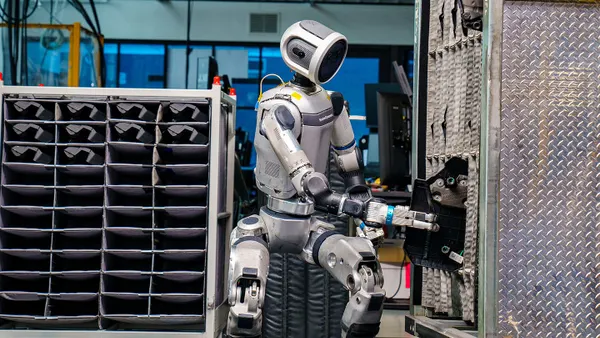
Today, manufacturers are calling this physical AI, and that shorthand covers a real change in how factory equipment is designed. On-device agentic abilities enable a robot to see a worker in its path, decide it should stop, and then explain what happened, all inside a deterministic power and latency budget.
For engineering teams making five-and ten-year procurement bets, the question is which processor architectures and which foundry partners can actually carry that workload through safety certification and into volume production, while meeting quality, efficiency, and performance targets.
The compute scarcity forcing inference to the edge
Part of the pressure to adopt physical AI is economic. GPU capacity remains tight into 2026, and smaller buyers regularly lose bidding contests to hyperscalers. The harder constraint, though, is what happens when a design team tries to squeeze a general-purpose GPU into a mission-critical embedded slot.
"What we run into are those power efficiency trade-offs," says Sean Murphy of MIPS by GF. "The large GPUs are very capable of training large language models (LLMs), and they have high cost and high power usage."
There's headroom for improvement in more targeted physical AI applications. They can benefit from a more tailored approach that addresses the right power envelope for the right performance target.
Latency is the second constraint, and for safety-critical platforms it is not negotiable. "The only way you get low latency is by running it locally," Murphy says. “This creates a new challenge to hitting the cost, power, and efficiency targets of the platform, and in turn driving the need for new technology to run agentic capabilities.”
Data sovereignty follows the same logic. Running a model on the device means the sensor data never crosses a corporate boundary, shrinking an exposure surface that CISOs at industrial firms increasingly refuse to sign off on. "By running locally, by definition, you're not shipping off to the cloud and are able to run directly on the device itself."
The upshot is that on-device inference has stopped being an optimization pass at the end of a design cycle. It is a first-order requirement now.
What physical AI looks like on the factory floor
Roboticist Mel Siegel at Carnegie Mellon spent decades describing autonomous machines using a sense-think-act-communicate model (STAC) that reduces any autonomous machine to four sequential functions:
• Sense: Sensors take in information about the surrounding environment.
• Think: A compute layer interprets those inputs and decides what to do next.
• Act: Actuators then translate that decision into physical motion, whether that is a robotic arm closing on a part or an autonomous cart changing course
- Communicate: Information is shared to help inform the next iteration of the signal-chain, enabling multi-system cooperation in disaggregated platforms
Siegel's insight was that the four core functions had to be engineered as a single closed loop rather than as separate subsystems bolted together after the fact, and that framing has held up as robotics workloads have grown more ambitious. Murphy describes STAC in the context of a modern assembly line, where the physical barriers between humans and robots are giving way to open floor plans built for throughput.
"You're talking about smarter robots, but you're also talking about that workspace being smarter," he says. Fixed cameras watch the shared zone, and robots carry their own tactile sensors alongside lidar and radar. A compute stack close to the equipment fuses everything in real time.
When something goes wrong, the equipment acts on its own conclusion rather than escalating to a human. "They're shutting the robot down to a safe condition," Murphy explains. "Maybe putting up a red warning light for the human to see."
Predictive maintenance on individual motors was the earliest version of this pattern to reach production, but transformer-based perception is now pulling factories toward richer situational reasoning across multiple sensing modalities. Agentic behavior, in other words, is arriving as a property of the equipment itself, not as a supervisory service running elsewhere.
The processor architecture carrying the workload
The silicon underneath that pattern is based on the RISC-V architecture. MIPS announced an architectural pivot to the open instruction set in 2021. GlobalFoundries' 2025 acquisition of MIPS placed the processor IP inside the foundry that manufactures it, which means one commercial relationship now spans architecture selection through wafer supply.
That reach expanded again when GlobalFoundries bought the ARC Processor IP Solutions business from Synopsys in 2026. ARC contributes processor IP running from low-power microcontroller cores through to application-class silicon, all traceable back to a single fab relationship.
Because everything sits on the same instruction set, a design team can put the sense-think-act-communicate stack on one software base rather than juggling processor IP from separate vendors. This shortens the path from prototype to a device that ships.
This shows up in MIPS' Atlas CPU portfolio, with cores sized across the range a physical AI system draws on: tight, deterministic real-time engines at one end for motor control and sensor fusion, and application-class processors at the other for perception and planning.
The newer S8200 NPU is also built around RISC-V, and combines a RISC-V host CPU with matrix and vector compute engines specifically at more complex workloads such as multi-modal environments, using the modular RISC-V standard extensions.
Industrial customers are already reaping the rewards. ForwardEdge ASIC, a Lockheed Martin subsidiary, has selected the S8200 for mission-critical autonomous platforms, and Inova Semiconductors is working with MIPS on a reference physical AI platform for robotics applications. Green Hills Software has committed to providing the safety-certified software stack that automotive and industrial customers need to close the loop.
Murphy concludes with advice for teams weighing the transition to physical AI. “Think big, but start small,” he says. “Target your biggest inefficiencies and start there. Predictive maintenance on a single motor is a defensible first step. Rebuilding a factory around agentic perception isn’t something anyone should try to do overnight. But if you choose a scalable architecture from the start, you can build toward that future without having to start over.”