
For decades, inbound logistics centers (ILCs) were treated as support functions: necessary, but less critical to overall efficiency than the work happening on the plant floor. That perception no longer holds.
Today, inbound operations sit at the intersection of supplier variability, labor execution, automation performance and plant readiness, governing how effectively materials flow into production.
Manufacturers under pressure from labor shortages, cost volatility, automation complexity and tighter customer expectations are increasingly discovering a hard truth: your inbound logistics center is no longer a staging area. It is a control point.
Why inbound is now mission-critical
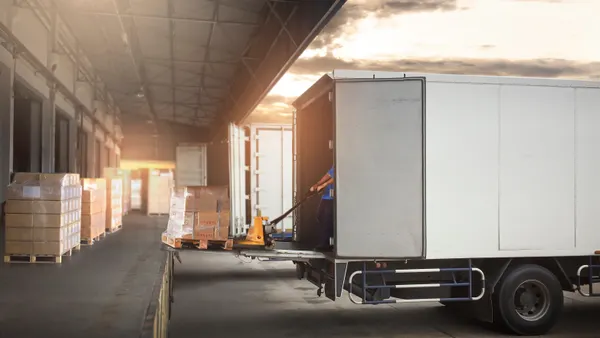
An ILC is the front door of manufacturing. Every part, pallet and container entering a facility must pass through it before production can begin. Its responsibility is deceptively simple: receive, process, stage and deliver materials to the line in the right condition, sequence and timing.
But the environment around inbound has changed.
Modern ILCs now operate amid supplier variability and inbound volatility; just-in-time and just-in-sequence production models; capital-intensive automation investments; strict uptime, quality and throughput requirements; and a consistent shortage of skilled and trained workers.
When inbound execution falters, the impact is immediate:
- Production slowdowns or line stoppages
- Overtime and premium labor costs
- Expedited freight and yard congestion
- Increased safety and quality risks
Manufacturers can no longer afford to treat inbound as a variable cost center. It must be actively managed, measured and aligned with production goals.
Six stages, one system
Inbound logistics is not a single process—it is a chain of interdependent stages. Failure at any point cascades downstream.
- Supplier arrival and pre-gate activity
- Yard management and dock assignment
- Dock operations and unloading
- Verification, quality and system capture
- Staging, sequencing, kitting and line-side prep
- Delivery to plant or point of use
Each handoff compounds risk if performance is inconsistent. In high-volume industrial and automotive environments, small inefficiencies quickly turn into system-wide constraints.
The pressure points
Most manufacturers face the same structural stress points in their inbound operations.
Workforce instability. Chronic labor shortages, high turnover and skills gaps create operational variability no process can fully absorb.
Throughput bottlenecks. Peak cycles overwhelm docks and yards, cascading into production delays.
Inconsistent productivity. Unload rates and quality vary by shift, with little visibility into root causes.
Automation friction. Equipment underperforms when workforce execution is not aligned with system design.
Rising cost and risk. Labor costs increase without productivity gains, while safety incidents and rework remain the manufacturer’s responsibility.
These pressures expose a core misalignment: many inbound labor models were built to provide coverage, not performance.
When coverage isn’t enough
Traditional third-party labor approaches often rely on temporary staffing, loosely defined KPIs and limited accountability. While positions may be filled, outcomes are inconsistent.
Common limitations include:
- High dependence on short-tenure workers
- Minimal skills training and oversight
- Poor retention of experienced associates
- Performance metrics that are vague or unclear
The result is a system where manufacturers pay for variability and absorb risk when execution fails.
Designing inbound for performance
Forward-looking manufacturers are rethinking inbound execution around one principle: performance must be designed, not assumed.
This requires four structural shifts:
Workforce stability. Consistent execution begins with who shows up and how long they stay. Full-time, trained associates create continuity across shifts and production cycles.
Aligned incentives. Hourly models reward time, not outcomes. Performance-based structures support intrinsic motivation and accountability by tying incentive pay to productivity, safety and service quality, aligning behavior with plant goals.
Clear standards and visibility. Defined KPIs, embedded safety and quality metrics and real-time reporting enable proactive management rather than reactive correction.
Outcome ownership. Focusing on performance and accountability for results rather than labor coverage results in a fundamentally different operating relationship.
By embracing these four structural shifts, manufacturers gain predictable performance and cost transparency while reducing their operational risks, while their provider assumes responsibility for delivering against agreed-upon KPIs. Together, these elements transform inbound from a variable into a lever.
A strategic advantage and a support function
Across many disparate manufacturing environments, performance-based inbound models have delivered measurable improvements: higher throughput, lower backlog, improved safety, reduced cost per unit and stronger readiness for automation.
As manufacturing evolves, inbound logistics will no longer be evaluated on how many people are present, but on how reliably it delivers production-ready materials to the line.
The future of inbound is not about labor coverage; it is about outcome ownership.
And for manufacturers navigating the next stage of operational complexity, the ILC may be the most important place to start.