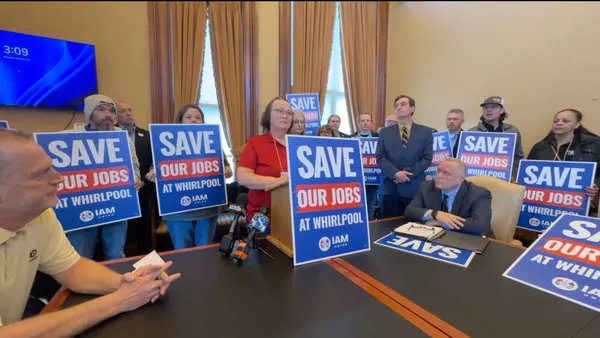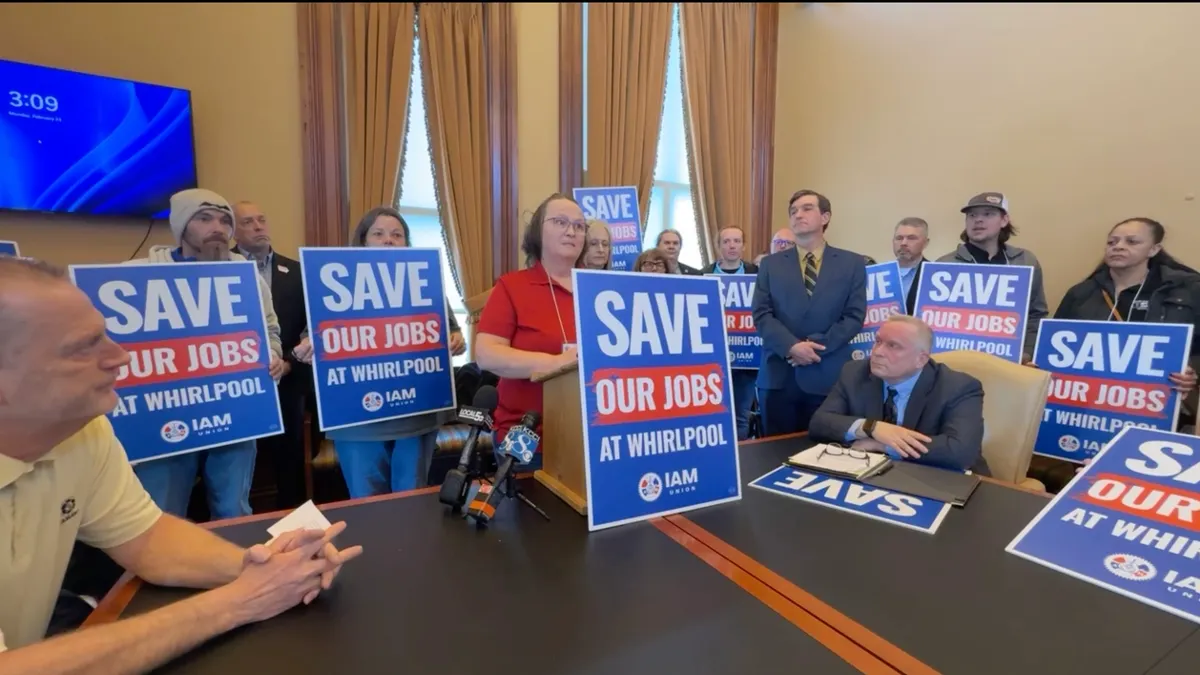
Whirlpool plans to lay off 341 employees at its manufacturing facility in Amana, Iowa, beginning March 9, according to a Worker Adjustment and Retraining Notification post on the state’s workforce development agency.
The impacted workers are represented by Local Lodge 1526 of the International Association of Machinist and Aerospace Workers union, according to the company’s WARN letter dated Feb. 17.
The appliance manufacturer will move production to Whirlpool’s facilities in Mexico, Sam Cicinelli, IAM’s general vice president of the Midwest territory, said during a press conference on Wednesday.
In an emailed statement on Thursday, Whirlpool said the Amana plant is “a vital part” of its manufacturing footprint.
“Our recent announcement is part of a multi-year modernization plan that will transform the plant into a dynamic operation that will continue to produce best-in-class refrigerators, while also incorporating warehousing, parts production and sub-assembly work,” the company said. “This transformation is necessary to position the Amana plant for continued stability and success.”
The upcoming Amana layoffs add to the 250 employees Whirlpool let go in July 2025, which Cicinelli said shows a pattern and not a “one-time business decision.”
The company initially informed Iowa Workforce Development in April 2025 that it planned to cut 651 workers, but later amended the WARN letter to state it laid off 250 workers. Whirlpool said it amended the notification to account for voluntary departures and retirements that occurred between the announcement of layoffs and the effective date of the job cuts.
Whirlpool also plans to initiate a second wave of layoffs by the end of the second quarter, Cicinelli said, adding that the job cuts will reduce the workforce to a “skeleton crew” at the Amana plant. The facility once had 3,000 IAM-represented workers at the facility, but it currently has about 1,300.
“They’re increasing the Mexican footprint in Mexico while they're depleting the American workforce,” Cicinelli said.
Whirlpool confirmed to Manufacturing Dive that it informed employees to anticipate additional job cuts in Q2 as it assesses its “operational needs.”
“We committed to sharing more information with them as soon as possible,” the company said.
IAM has been reaching out to state lawmakers about the layoffs, urging them to help save jobs at the Amana plant. IAM International President Brian Bryant also sent letters to them, as well as to U.S. senators and members of Congress representing Iowa.
“[Whirlpool] is also signaling their plans to lay off hundreds of additional workers by the end of 2026,” Bryant said in the letters. “If not halted, these combined layoffs will leave more than a thousand working men and women in Iowa out of work with devastating impacts to their families and the regional economy.”
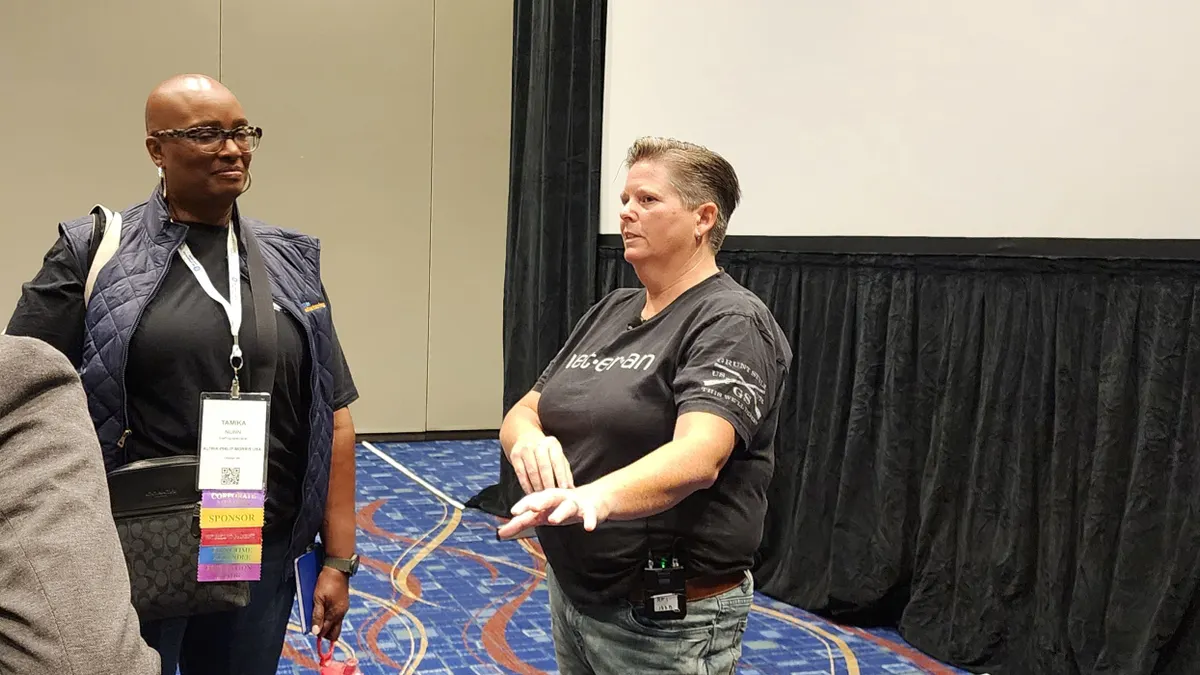
Kerry Waddell, an assisting business representative at IAM District 6, said at the press conference that she worked at Whirlpool’s Amana facility for 36 years and witnessed firsthand the company reducing the major assembly lines from five to two and moving production elsewhere.
Waddell added that Whirlpool said it plans to shutter a fourth assembly line and reduce shifts on the remaining assembly line from two to one by the end of Q2.
“What we’ve seen is a systematic disassembly of the entire plant, while we’ve seen the Mexico facility grow, and the Mexico facility is going to be producing units that we used to make and sell to the [North American] consumer,” Waddell said “Our position is, ‘Let’s make those in the United States, for the United States market.’”
Whirlpool said in its Q4 2025 securities filing that it is “well positioned for success” amid the tariff environment, as approximately 80% of its major appliances sold in the U.S. are domestically manufactured. Moreover, approximately 96% of the steel used to produce the appliances is domestically sourced.
Nevertheless, tariffs hit the appliance manufacturer in 2025, costing the company $300 million, “largely for components and some finished products, while the industry did not yet move on pricing,” Chairman and CEO Marc Robert Bitzer said during a Jan. 29 earnings call.
However, Juan Carlos Puente, Whirlpool executive president of North America and global strategic sourcing, said in an September 2025 interview with El Economista that the company is repositioning itself to have a more regional supply in Mexico.
Puente added that 80% of the appliance components originated from North America, with 70% coming from Mexico, giving the company a “more robust supply chain,” according to an English translation of his comments.
Puente said that components from the region give the company a “more robust supply chain.”
Whirlpool was also in the process of investing more than $250 million to expand capacity at its Mexico-based operations, with $150 million going toward its Ramos Arizpe plant, Puente said. The sites would manufacture newly launched products that had not been made in Mexico before. The Ramos Arizpe project, which includes a 236,806-square-foot facility, was completed in August 2025.
In another September 2025 interview with Milenio, Puente said the regional supply chains are more successful, with Mexico playing a strategic role. Moreover, Whirlpool’s Mexico-based facilities have a workforce of approximately 11,500 and are moving toward 13,000.
While Whirlpool’s Mexico operations have thrived, its U.S. operations have declined, with facilities shuttered since the company entered the Mexican market in 2002. The company has closed plants in Arkansas and Tennessee and moved production to Mexico, David White, IAM’s strategic resources director, said during Wednesday’s press conference.
Sandra Lorenz, who has been at the Amana plant for 33 years and serves as IAM Local 1526’s third plant chair, said workers are “scared and worried” about their jobs.
For one thing, the factory is located in a rural area and offers few job opportunities. Furthermore, Iowa implemented a new law in July 2025 that decreased the unemployment tax rate employers paid, leading to reductions in the unemployment fund.
“So some of them might not have any unemployment when they get laid off on the 9th,” Lorenz said. “It’s hard to look someone in the eye and tell them you don’t know what to do for them.”