

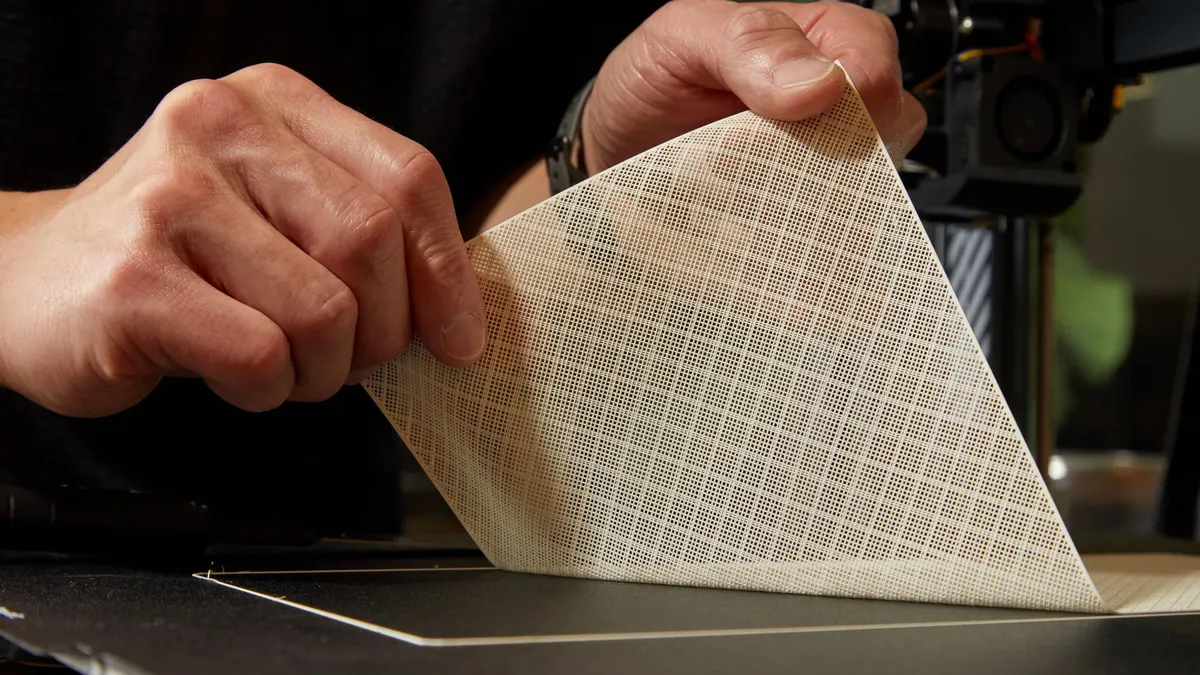
Variloom’s filament and 3D printing system is designed for customized and extremely efficient fabrication of versatile and recyclable fabrics. Its on-demand, on-site 3D print-to-shape technology lets brands design and produce customizable, recyclable fabrics in days instead of months, reducing waste, minimizing excess inventory and lessening reliance on offshore manufacturing.

In addition, the Palo Alto, California, company’s proprietary soft material, made from bio-based thermoplastic polyurethane and natural textile waste, can be tailored to incorporate performance features such as moisture wicking or odor control. It can be used for everything from shirts and pants to handbags and shoes, and recycled up to three times without losing quality.
Bethany Meuleners is a designer with two decades of experience in apparel, footwear, accessories and textiles. Before becoming venture lead at Variloom, she co-founded Mansoor Scott, a contemporary women’s knitwear label, and took on leadership roles Betabrand, The Comfy and Stella & Dot.
Meuleners recently spoke with Manufacturing Dive about Variloom and how 3D printing is set to transform apparel manufacturing — including her vision for a future where in-person retail customers get custom-made pieces while they wait.
This interview has been edited for clarity and brevity.
MANUFACTURING DIVE: How did you come to work at Variloom, and what is the company’s overall mission?
BETHANY MEULENERS: I've spent over 20 years in the fashion industry, primarily working across product design, product development, product strategy. I've helped launch products and apparel and product programs for everything from small startups to larger companies, so I've seen the supply chain from a lot of different angles. I've experienced firsthand the inefficiencies, waste and other problems that the industry has. The problems that Variloom is trying to solve regarding overproduction, long lead times and offshore manufacturing are things that I understand very well.
Our main thing is rethinking how materials and products are made in soft goods and fashion. We've built a 3D print-to-shape system and proprietary recyclable material that fits within that system. The idea is that brands and suppliers can produce customizable fabrics on demand and on site in a much shorter time frame — think days instead of months. Traditional supply chains for fashion can be anywhere from three months to a year, and decisions are being made about products well before that. This can lead to overproduction and incorrect guesses on what's going on in fashion.
What we're building is in direct response to that. We’re building a new supply chain that incorporates 3D printing and additive manufacturing, working with both brands and suppliers. Our public partnerships thus far are with YKK and Rip Curl, as well as some supply chain partnerships. We're focused on scaling our technology with those partners and moving forward to continue to work in the apparel space.
What kinds of products do you currently make, and what are you looking to expand into?
We’re doing components and parts, not necessarily completely overhauling entire products. The idea there is brands bring in a level of customization and design details that they can't get through traditional methods, and certainly not without doing very large quantities. For example, we’re doing customizable zipper pulls with YKK. For Rip Curl, we specifically designed and developed components to go into their board shorts that can help solve problems that surfers have, like board shorts riding up. We're also continuing to push the boundaries of our large-format printing, where we're moving into whole garments and whole products.
We really focus on building the system and the material, and then working with brands and suppliers. We like to understand what problem they're trying to solve and what end product they're trying to make, and how we can not just create a great product for them, but utilize our system, utilize our materials to solve it in a way that adds value. Through 3D printing, we can have targeted structures. We can build something up layer by layer. We can bring in added value in a way that's unique to our system.
Currently, we work with brands and suppliers to create products that are specified to their brands. But ultimately — and I think this will be in the next couple years — customers will be able to go into a store, pick out a product, have it customized and made for them while they wait. While we may not be there today, we will be there in the near future.
How does your 3D printing process reduce production time so dramatically?
To take a step back, we really wanted to to look at how we could improve and fit within existing apparel manufacturing systems. The idea is not to completely overhaul everything that's going on. So we spent the early days really honing in on and developing our proprietary material that could truly create a customizable and printable wearable material. Because when you think about 3D printing, most people think about harder objects.
And it's not just about gaining flexibility — it's about producing something that you actually want to wear. So we didn't completely reinvent and overhaul 3D printing. We intentionally made a material that fits within existing printing systems, and then we're making improvements with our software and with the parts, and then how our material interacts with those systems.
Doesn’t 3D printing actually take longer than traditional manufacturing because you’re printing each individual, customized product?
If you look at the history of 3D printing over the last 10 years, print speed has made, and continues to make, very large improvements on throughput, but that's really only one part of the equation. Where we come in is that traditional manufacturing might be fast on the production floor, but you’re also producing thousands and thousands, if not hundreds of thousands, of units. By the time you factor in the full timeline, including the design finalization, sourcing, overseas shipping, customs and distribution, you're looking at months before a product actually reaches the customer.
By having on-demand production closer to the consumer, you can compress that entire cycle. You're cutting out a lot of those steps. So even as we continue to increase throughput, and while maybe on an individual product basis it might be a little bit longer than traditional methods, the time-to-customer advantage allows for better planning and better interactions with the customer and opens up more opportunities for customization.
At this stage, we're not trying to replace the process for companies that are making 100,000 units. We want to have a greater level of decision making and product customization closer to the point of sale. Mass-produced products are where we're seeing overproduction, fast fashion, trying to get everything out there. But that push for making thousands of units comes from traditional textiles, where you have to buy thousands, if not tens of thousands, of meters of fabric to be able to do something.
Imagine if you could take that part out of the equation, where the material itself can be developed in a way that is specific to the needs of the customer, where you can add in more stretch, or you can make it more solid, or add in customized details in ways that you just can't get with traditional materials because of those very large quantities. I think that consumers are hungry to have a little more connection with the products that they're buying and consuming.
Have you quantified how much money apparel companies could save using on-demand 3D printing compared with traditional manufacturing?
We're in the process of building a calculator to be able to show the money and time savings that could work into individual products. But generally speaking, with traditional cut-and-sew manufacturing, some 15% of materials are wasted just from cutting. So if someone spends, say, $100,000 on textiles, $15,000 of that essentially is wasted on the cutting room floor. Having solutions where you can print to shape reduces that waste and produces savings.
What are some of the barriers you see to the apparel industry adopting 3D printing technology more broadly?
I think that a lot of brands have very distinct supply chains that they've been working in for a long time, so I think that any change — because it does require a change — in thinking about how the product is designed, how the product is delivered to the consumer, can be challenging. And you know, everybody has margins, everybody has deliveries that they need to meet.
So I think it's really about finding the right people and organizations who really want to push that innovation, do those pilot tests, show that taking a step away from the traditional supply chains and traditional methods can actually open up new opportunities rather than disrupting their normal cycles. I think it's a bit of an education and finding the right people to step in and test those pilots to show that it works.
We have gained a lot of interest, and we are talking to some really great innovators, great designers, great product people who see the future that we see. So we're very excited about it.