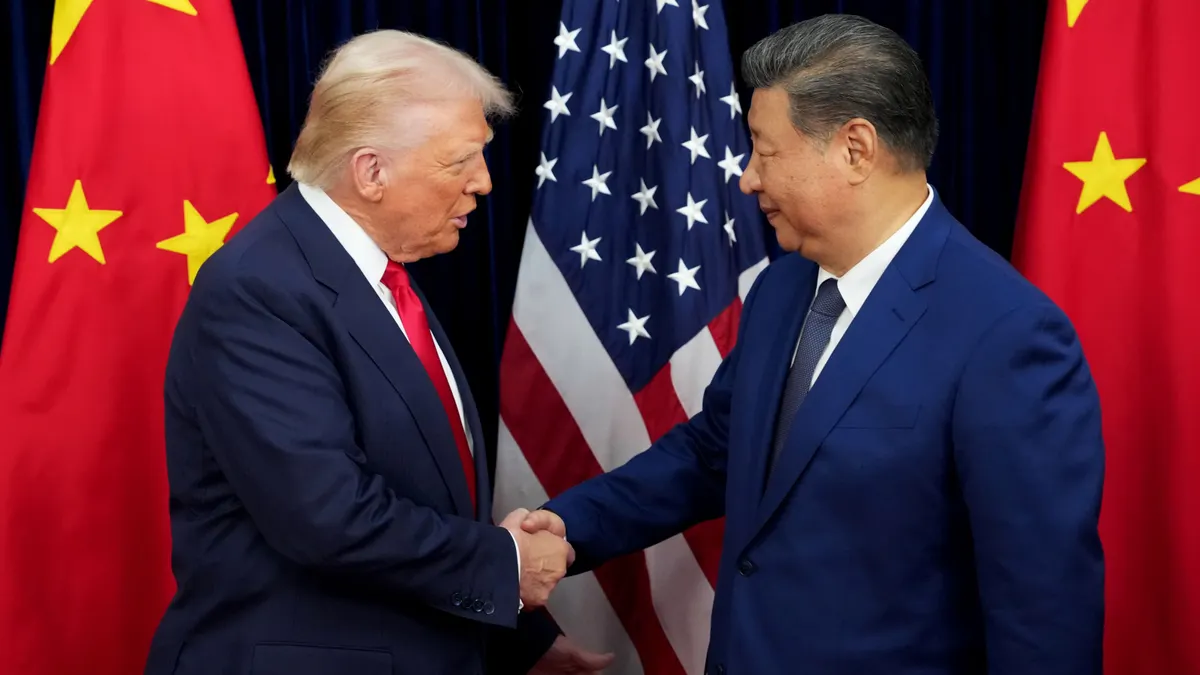

The United States and China reached a consensus agreement related to tariffs and other trade-related priorities during a Thursday morning meeting in South Korea between the countries’ leaders and other officials.
As part of the arrangement, the U.S. will lower tariffs related to fentanyl trafficking on imports from China to 10%, down from 20%, effective immediately, U.S. President Donald Trump told reporters Thursday on Air Force One. A spokesperson for China’s Ministry of Commerce confirmed the reduction and also said the U.S. would further extend its pause on reciprocal tariffs on imports from China for another year.
Meanwhile, the U.S. will maintain certain Section 301 tariff exclusions until Nov. 10, 2026, per a White House fact sheet, published Saturday. Such exclusions were set to expire on Nov. 29 of this year.
Despite the tariff reductions, goods from China will still face a duty burden of 47%, Trump and U.S. Trade Representative Jamieson Greer said Thursday while traveling to the U.S. from South Korea.
“A variety of other tariffs still remain. Section 301 tariffs from the original, a variety of Section 232 tariffs,” Greer said. “Some of these tariffs are, as the president mentioned, around 40%. For some individual products it may go up to 100%, but as a general matter it's about 45, 47%.”
Beyond tariffs, the U.S. will suspend its Section 301 investigation on China's maritime and logistics industries for one year, according to Greer. The U.S. will also suspend the “responsive actions taken” following the probe for one year, per the White House fact sheet. The investigation had led to fees on China-linked ships calling at U.S. ports, among other actions, as well as countermeasures from China. China plans to remove its countermeasures to the fees for one year, after the U.S. suspends its actions, per the Ministry of Commerce spokesperson.
Meanwhile, China agreed to pause implementation of export controls on rare earths announced earlier this month by one year, the Ministry of Commerce spokesperson said. The country also agreed to resume issuing rare earth export licenses for rare earths and implement stricter chemical export controls to address fentanyl shipping, the White House Fact sheet said. In turn, the U.S. will suspend a September rule that placed export restrictions on companies that are at least 50% owned by entities that could pose a national security risk.
China will also suspend any retaliatory tariffs and non-tariff countermeasures it has enacted since March, according to the White House fact sheet. In addition, the country will “take appropriate measures to ensure the resumption of trade” from semiconductor-maker Nexperia’s facilities in China.
Trump said in a Truth Social post Thursday that China also agreed to buy “massive amounts of Soybeans, Sorghum, and other Farm products” and “begin the process of purchasing American Energy.” Per the White House’s fact sheet China will buy 12 million metric tons of U.S. soybeans in the next two months and then purchase 25 million metric tons annually for the next three years. IT also agreed to resume buying U.S. sorghum and hardwood logs. The Ministry of Commerce has not yet confirmed these details.
Although official documentation of Thursday’s agreement has yet to be published, both countries confirmed that the provisions will be renegotiated annually. In addition, the Ministry of Commerce said in a press release that both sides will work to resolve economic and trade issues and finalize terms as soon as possible.
Thursday’s agreements followed a face-to-face meeting between Trump and China President Xi Jinping in South Korea during the Asia-Pacific Economic Cooperation summit. The long-awaited meeting came following months of negotiations and retaliatory trade actions from both countries.
“Given our different national conditions, we do not always see eye to eye with each other and it is normal for the two leading economies of the world to have frictions now and then,” Xi said in translated remarks during the bilateral meeting with Trump. “And in the face of winds, waves and challenges, you and I at the helm of China-U.S. relations should stay the right course and ensure the steady sailing forward of the giant ship of China-U.S. relations.”
Editor’s note: This story has been updated with additional details from a White House fact sheet published Nov. 1.