Dive Brief:
- Taiwan Semiconductor Manufacturing Co. ended 2025 with a net revenue of $122.4 billion, a 35.9% increase compared to last year, due to continued demand for artificial intelligence.
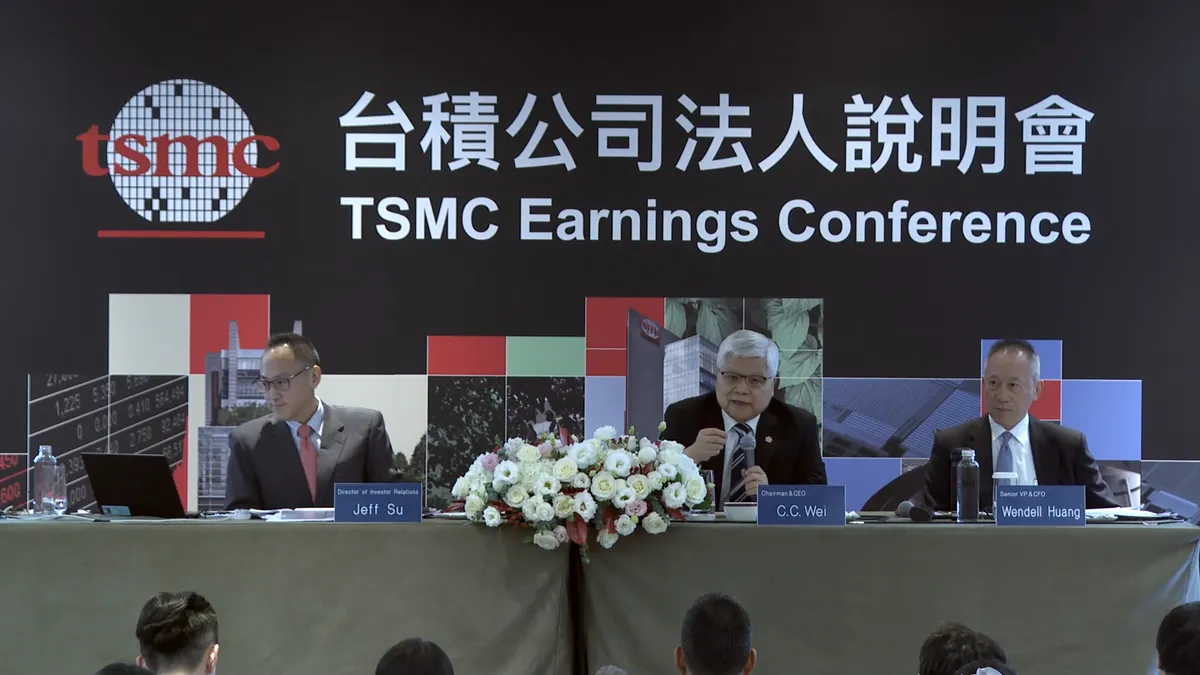
- Net revenue for TSMC’s fourth quarter increased 25.5% year over year to $33.7 billion, slightly higher than its guidance of $33.4 billion, CFO Jen-Chau Huang said on an earnings call Thursday.
- Looking ahead, the company expects Q1 revenue to be between $34.6 billion and $35.8 billion, supported by continuing demand for chip process technologies, Huang said.
Dive Insight:
TSMC expects 2026 to be another strong growth year and anticipates full-year revenue to increase nearly 30%, Chairman and CEO C.C. Wei said on the call.
Distinct technology and a broad customer base led to TSMC’s net revenue growth in 2025, as the wafer manufacturer has monitored increasing AI-model adoption across the consumer, enterprise and sovereign AI segments, Wei added.
“This is driving need for more and more computation, which supports the robust demand for leading-edge silicon,” Wei said. “Our customers continue to provide us with a positive outlook.”
Additionally, TSMC’s cloud service provider customers are sending “strong signals” and reaching out to the company directly, requesting capacity to support their business.
High-performance computing accounted for 58% of the company’s net revenue in 2025, up from 51% in 2024. Smartphones accounted for 29% of net revenue, down from 35% in the prior year.
Wei provided an update on TSMC’s global manufacturing footprint, adding that all of the Taiwan-based company’s overseas decisions are based on customers’ needs as “they value some geographic flexibility and a necessary level of government support.”
In March 2025, TSMC announced plans to invest an additional $100 billion in the United States, bringing its total investment to $165 billion. The expansion includes plans for six advanced wafer manufacturing fabs in Arizona.
Construction of TSMC’s second fab in Arizona is complete and tool moving and installation is planned for later in 2026. Due to strong customer demand, Wei said the company is also advancing the second fab’s production schedule and expects to begin “high-volume” manufacturing in the second half of 2027.
Construction on the third Arizona fab has begun and TSMC is in the process of applying for permits to begin building its fourth fab and first advanced packaging fab. Moreover, Wei said the company completed the purchase of a second large piece of land near the facilities, which would provide more flexibility to address the “very strong AI-related demand.”
“Our plan will enable TSMC to scale up an independent giga-fab cluster in Arizona to support the need of our leading-edge customers in smartphone, AI and [high performance computing] applications,” he said.
The Wall Street Journal reported on Jan. 12 that TSMC was planning to expand once again in the U.S. as part of a $250-billion trade deal with Taiwan that aims to reshore the domestic semiconductor sector.
Wei neither confirmed nor denied that the company was growing its U.S. presence, but said the recent land purchase was an indication. He said all of the company’s U.S. customers are asking for “a lot of support” from the Arizona fab, driving TSMC to accelerate its expansion in the state. The CEO added that capacity is “very tight” and that the company is working on narrowing the gap.
“That’s what we plan to do because we need it,” Wei said. “We are going to expand many fabs over there and this gigafab cluster can help us to improve the productivity, to lower down the cost and to serve our customers in the U.S. better.”