Dive Brief:
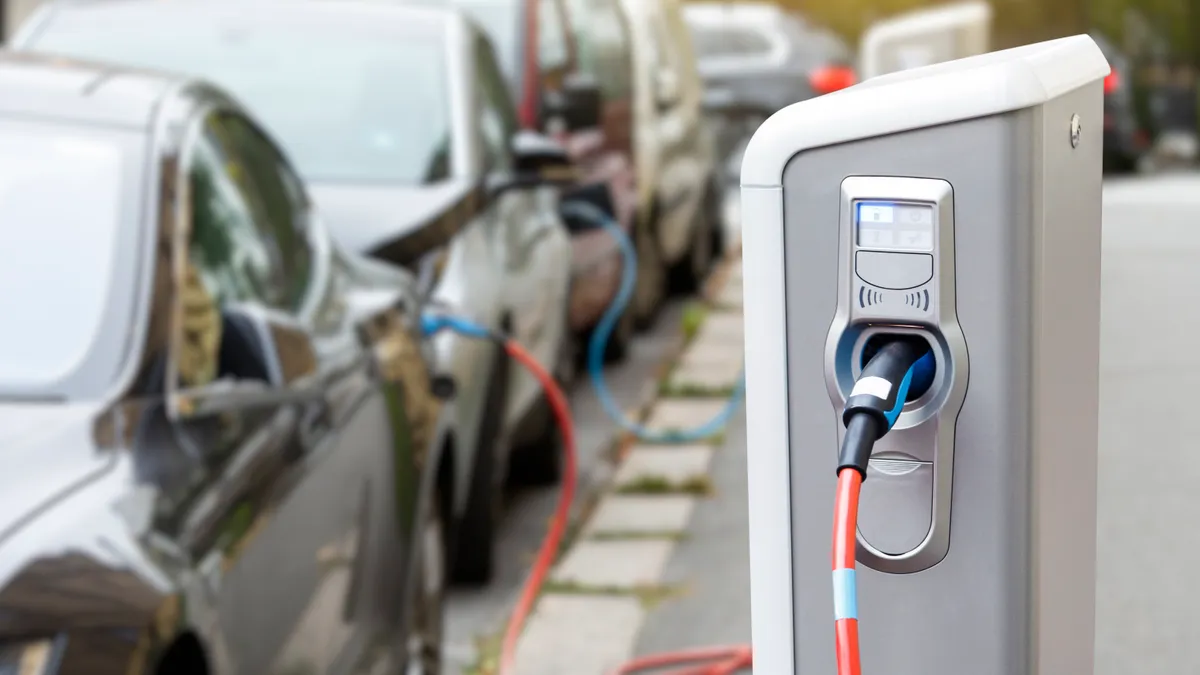
- The Trump administration on Tuesday moved to restrict federal funding for electric-vehicle chargers as part of its broader manufacturing agenda.
- The Federal Highway Administration proposed to raise the domestic content requirement from 55% to 100% in its “Buy America” waiver for EV chargers. This would require nearly all charger materials, including iron and steel, to be made in U.S. facilities in order to receive federal funding.
- U.S. Transportation Secretary Sean Duffy said in a statement that the update will strengthen domestic manufacturing, create jobs and address potential national security concerns. However, critics argue the stricter requirements are unrealistic given current limitations of the U.S. supply chain.
Dive Insight:
The Federal Highway Administration designed the proposal as an incentive for manufacturers to shift their production domestically. The Trump administration said it believes that companies today are able to produce EV chargers in U.S. facilities, in part, because 2023 supply chain issues have subsided.
The Biden administration allowed waivers to the existing 55% “Buy America” requirement to help accelerate the installation of a national charging network and prevent bottlenecks with domestic producers of steel, iron and other materials. The temporary waiver applied to all EV chargers manufactured by July 1, 2024, and whose installation began by Oct. 1, 2024.
Companies like Tesla, Love’s and Francis Energy Charging have greatly benefited from EV charging aid in recent years, securing $37.4 million, $57.1 million and $107.8 million, respectively, as of Feb. 12, according to data compiled by the National Association of State Energy Officials.
The new waiver proposal, if finalized, would restrict funding for EV chargers unless they were primarily made of materials produced in the U.S. Renewable energy experts say this is not feasible with today’s global supply chain.
“Without corresponding domestic production capacity in place, this proposal would undermine the very manufacturing growth it seeks to promote,” Trisha Dellolacono, head of policy at Calstart, a California-based nonprofit focused on renewable transportation, said in a statement.
The waiver’s existing 55% requirement reflects the reality that components like LCD displays, transformers, charging cables, circuit boards and other materials cannot be manufactured at scale in the U.S., Dellolacono said. Setting a 100% requirement “essentially blocks the implementation of critical infrastructure” as the automotive industry shifts to EV production, she added.
The waiver update would also affect the implementation of charging stations along America’s highways, funded under the National Electric Vehicle Infrastructure initiative. This $5 billion program, enacted in 2021, has been under attack by the Trump administration since the president took office.
The administration abruptly and indefinitely froze the NEVI program last February, blocking the flow of federal funds to several states. A group, led by Washington, Colorado and California, subsequently sued the Transportation Department. A preliminary injunction lifted the freeze in June and the agency issued revised guidance for the program in August.
Less than three weeks ago, a federal judge ruled the Trump administration violated federal law and ordered the Transportation Department to release obligated funds.
Katherine García, director of the Sierra Club’s Clean Transportation for All campaign, said in a statement that the new waiver update was just another attempt to kill NEVI and block the buildout of EV chargers.
“Supporting American manufacturing is essential — but sabotaging a major infrastructure program and undermining U.S. competitiveness is not ‘America First,’” García said.
The Federal Highway Administration will consider public comment on the waiver update over the next 30 days.