

Many manufacturers are getting better at managing their own internal artificial intelligence data with stronger systems, better governance and clearer workflows. However, product, compliance, shipment and packaging data has to move across multiple parties in the supply chain.
As a result, even when manufacturers have strong internal processes, it can be hard to ensure every trading partner is working from the same information.

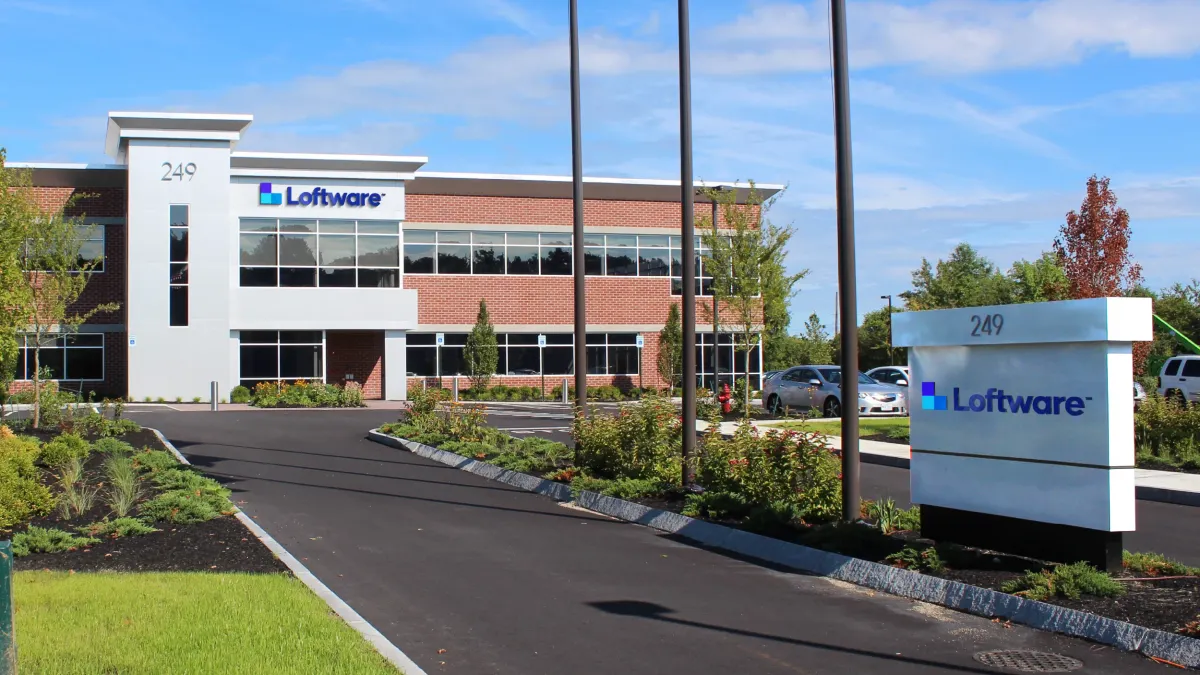
Loftware has developed an AI-enabled system called Loftware Connect that helps suppliers, plants, logistics providers and others in the supply chain communicate information and coordinate their operations.
“We put product packaging and labeling on goods so that when they exchange hands, people know what to do with them,” CEO Jim Bureau said. “If you're my supplier, I can say to you, ‘Hey, when you send me goods, make it conform to this standard.’ That's really hard to do if you're a supplier because you might have hundreds or thousands of customers that you're trying to do that with.”
Bureau recently spoke with Manufacturing Dive about the issues that different companies in the supply chain face when communicating with one another.
This interview has been edited for clarity and brevity.
MANUFACTURING DIVE: Tell us more about the services Loftware provides.
JIM BUREAU: One of the challenges is, if I go to define how I want to do business with you, how do I make that easy? Our system, Loftware Connect, allows me to define how I want my packages and shipments labeled, and I can publish that to you. That means you don't have to go back and rewrite it.
Historically that's how things worked: You defined how you want to do something, and you had to go and write your labeling software to facilitate that. This means that over the years, label templates have proliferated throughout large manufacturers. We have customers who have 60,000 or 70,000 label templates they’re navigating through.
With our AI system, you can say, “I'm going to ship a new product to Apple, and it's this type of product. Do I already have a label out there that conforms to that standard?” You can use our system to search for that, which takes that 60,000 number down to something more manageable.
If you don’t already have a label, we can help determine the standard that Apple wants and how to use AI to generate a template to conform to that standard. If you're my supplier and I ask you to do something like that, it requires a back-and-forth exchange about how I want to receive my goods and services. Then you have to go build the template, and you to have me validate that it's right and actually put it into production. That's usually a four-to-five-month process for one product. If I'm Ikea and have thousands of products, it's a huge lift. We help companies do that faster.
How can AI-enabled systems like yours help prevent miscommunication between companies throughout the supply chain?
What oftentimes happens is, everybody's got their own AI initiatives that they're doing within their own four walls. That’s great, but supply chains are heavily dependent upon goods coming and going across them.
We've got automotive customers that get advance shipping notifications and things of that nature in terms of what's coming in and what's not. Inevitably, what we have found is that even with those systems, I send you an advance shipping notification telling you you're getting 50 of something. Then you pop open the box, and guess what? There's 30 in there, or it's the wrong mix.
Loftware Connect gives trading partners visibility into what's actually coming off the production line on an item-level basis and what goes into the box before and as it's going out the door. We tie those two together and reconcile those with advance shipping notifications to say, “You're expecting 50, and 50 actually went in the box, and it was the right thing that went in the box.” If I can find that out ahead of time, and I'm an auto manufacturer, it saves me a huge amount of time in a production line to get throughput.
How did these packaging and labeling problems arise in the first place?
It's just a gap that's been in existence for years.
You have a vendor who's requiring you to comply with their packaging standards, and you have to get it right. What people typically do is go into their labeling and packaging systems and create the standard they want to follow. Then they'll take a picture of it and attach a 25-page document with how they want it packaged, and then they'll email it to you, and then you’ll go into the exact same system that they were just in and recreate the wheel.
Even just with Loftware alone, I can go to an automobile manufacturer and say, "Who are your suppliers?” Chances are we have 60%, 70% of their suppliers as customers. So if I can just solve that problem within our own four walls and allow them to do a publish and subscription model where I can apply artificial intelligence because now all the data is contained in one spot, it completely changes the dynamics of how companies have approached the packaging and labeling aspects of the supply chain.
What should manufacturers do first to begin alleviating the packaging and supply chain issues we’ve discussed?
When people are thinking about packaging and labeling, those decisions often happen at a local level. You have a problem in a business unit in a local jurisdiction, and you make a decision for what might appear to be a tactical problem. Well, add those together. If you’re a large company and spread that across an enormous platform, you've got a mess.
So, whether it's Loftware or not, you need to think about this problem as an enterprise. First and foremost, you need to get on the cloud. If you get on the cloud, irrespective of your trading partners, you can manage your own business to start with.
The cloud also opens up a world of opportunity to be able to exchange real data with your trading partners, and and ultimately control how they represent your product. When you change something once, it ripples across the entire supply chain, and you can't get there without being on the cloud.