Dive Brief:
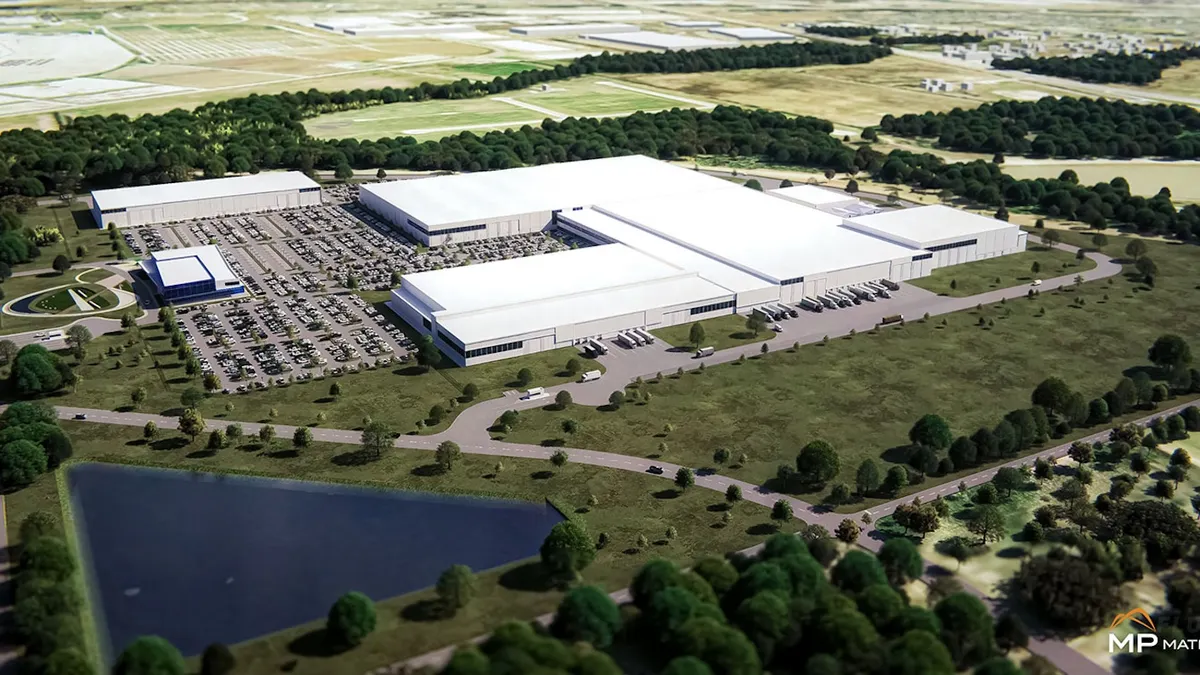
- MP Materials announced on Feb. 26 that it has chosen Northlake, Texas, as the site for its $1.25 billion rare earth magnet manufacturing campus.
- The site, dubbed 10X, is expected to add to MP’s annual production capacity of approximately 10,000 metric tons of neodymium-iron-boron, or NdFeB, rare-earth magnets, according to the press release.
- Construction is forthcoming, though engineering and equipment acquisition are underway and a date was not disclosed. The campus is anticipated to create more than 1,500 manufacturing and engineering jobs and commissioning is set to begin in 2028.
Dive Insight:
The 10X manufacturing campus is part of MP’s 10-year agreement with the Department of Defense, signed in July 2025, to accelerate a build-out of an end-to-end domestic rare earth magnet supply chain. The deal also aims to reduce U.S. dependence on foreign entities, according to the press release.
“In alignment with the [DOD], we are advancing this project with urgency and disciplined execution,” James Litinsky, MP’s chairman, president and CEO, said on a Feb. 26 earnings call.
The deal includes DOD’s agreement to purchase $400 million in the company’s preferred stock convertible into common stock, making the agency MP’s largest shareholder. Moreover, DOD has the authorization to buy additional shares.
DOD also agreed to guarantee 100% of the magnets produced at 10X will be purchased by defense and commercial customers with shared upside. Additionally, the multiyear contract includes an established commitment of $110 per kilogram for MP’s neodymium-praseodymium products stockpiled or sold to reduce vulnerability to “non-market forces.”
Furthermore, the 10-year contract provides MP with a $150 million loan from DOD’s Office of Strategic Capital to add heavy rare-earth separation capabilities to the company’s existing processing facility in Mountain Pass, California. The loan funds were allocated through the One Big Beautiful Bill, which President Donald Trump signed into law in July 2025.
The light and heavy rare earth raw materials processed from MP’s Mountain Pass facility will support 10X, according to the Feb. 26 press release. Scrap from Texas magnet production will be reintegrated into MP’s recycling circuits in the state and California to tighten cost performance across its platform.
“We are focused on getting this online as quickly as possible,” Litinsky said during the call. “We’ve said we’ll be commissioning [10X] in 2028. We’ve made a lot of progress. We think it’s on track, and we’ll keep trying to make up as much time as we can as aggressively as we possibly can.”
MP has also received $200 billion in state incentives, including a $12.9 million grant through the Texas Enterprise Fund and a $53.5 million grant funded through the Texas Semiconductor Innovation Fund, according to Gov. Greg Abbott’s press release.
MP and DOD’s multibillion-dollar deal had U.S. senators questioning the agency’s officials at a Feb. 25 Armed Services Committee hearing, particularly regarding equity investments under the Defense Production Act.
“The legal basis, in particular, appears questionable,” Sen. Jack Reed, D-R.I., said during the hearing. “The department has argued that the Defense Production Act provides the authority for these investments. However, while the Defense Production Act does authorize the purchase of industrial resources for government use, it does not mention equity investments at all.”
Reed also said he heard from various mineral companies that DOD’s equity stake and 10-year price floor puts them at a “competitive disadvantage.”
Michael Cadenazzi Jr., assistant DOD secretary for Industrial Base Policy, said the agency felt the MP deal was necessary at the time to “immediately stimulate rare earth’s investment and demand.”
“The price floors are determined by a set of open market analyses reflecting our best understanding of what an open Western market would look like, as opposed to the manipulated Chinese price floor,” Cadenazzi said. “As we’ve seen since that time, prices domestically have actually increased to the point where they're roughly, in some reports, around 110 per kilogram, which is where the price floor is at.”
Additionally, the U.S. government has been in talks with foreign mineral firms, including Brazil-based Serra Verde, Australia-based Alcoa and Saudi Arabia-based Maaden, to supply minerals to MP materials, Cadenazzi said.