Dive Brief:
- Micron Technology is increasing its U.S. commitment to spend more than $250 billion through 2035, fueled by soaring demand for its dynamic random-access memory products, according to a press release Thursday.
- Additionally, the company is spending up to $3 billion to fortify the domestic semiconductor supply chain. That investment isn’t part of Micron’s increased pledge, a company spokesperson said in an email.
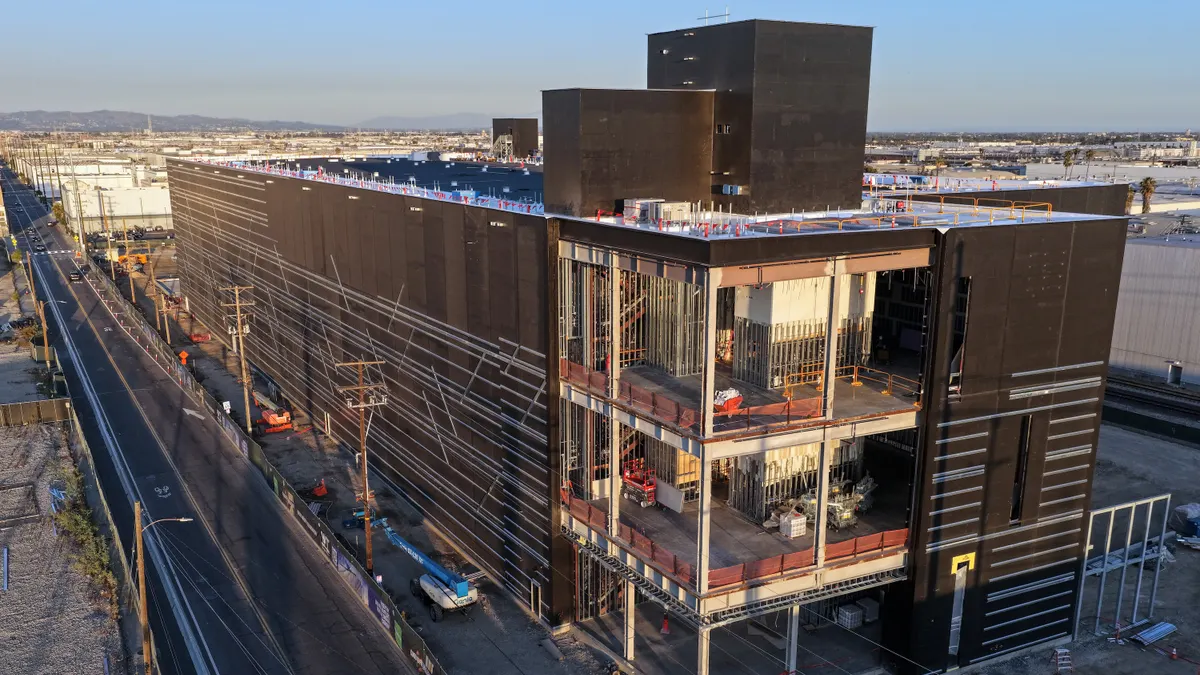
- The announcement comes as Micron completed worksite less than six months ahead of schedule, shifting to vertical construction of its $100 billion semiconductor fabrication campus in Clay, New York.
Dive Insight:
Micron said the investment reflects its commitment to stabilizing and improving U.S. supply of critical manufacturing materials, assurance and flexibility.
The pledge also supports the growing demand for advanced memory and storage solutions driven by artificial intelligence and other systems handling large data quantities.
Micron expects the increased investment will back its long-term goal of producing 40% of its DRAM products in the United States, according to the press release.
The money also reflects the company’s confidence in its technology and memory products driven by rising demand in the artificial intelligence infrastructure and data center end-markets. Micron’s fiscal third quarter revenue generated $41.5 billion, a 346% year-over-year hike from $9.3 billion.
“We are only in the early innings of the significant innovation and productivity that can be unleashed in every part of the global economy over time,” Sanjay Mehrotra, Micron president and CEO, said in his prepared statement in June.
The company anticipates data center growth will be driven by AI-powered features in smartphones, PCs and new consumer electronics, as well as in automotive, industrial operations and robotics, Mehrotra added.
“Exciting possibilities enabled by robotics and humanoids, as well as fully autonomous vehicles, portend a robust long-term demand environment for memory and storage,” the CEO said.
However, the increasing demand highlights memory and storage supply shortages, which Mehrotra said “will take considerable time to improve.” Supply growth relies on significant new fabrication facilities expansions that are “large, complex and time consuming,” he added.
“The pace is constrained by several factors, including long lead time for fab construction across the world, shortage of workers with critical trade skills, complex regulations including permitting, and the need for enhanced energy infrastructure,” Mehrotra said. “Meanwhile, memory process technology, which is among the most advanced to develop and manufacture in semiconductors, is getting more complex with every new node.”
Machine learning systems are powered by AI chips, such as graphics processing units and application-specific integrated circuits. AI chips meet intensive algorithm demands that a central processing unit cannot meet, according to IBM.
However, GPU, ASIC and CPUs depend on memory subsystem performance and capacity, Mehrotra noted.
“This has given rise to a more complex memory hierarchy that is providing greater differentiation opportunities for Micron than at any time in our history,” he said. “It has also elevated the role of memory in the AI world to a strategic asset.”
Micron is taking steps to secure and stabilize the U.S. supply chain, including spending up to $3 billion in its suppliers, such as GlobalWaters. The investment includes $500 million to expand manufacturing and research and development capabilities at GlobalWafer’s 300mm raw silicon wafer plant in Sherman, Texas.
The two companies also inked a 10-year supply agreement and plan on collaborating to develop wafer technologies and processes to support future semiconductor manufacturing requirements, according to the press release.
“Through this close collaboration with Micron, we are not only continuing to meet market demand for high-quality semiconductor wafers, but also helping to strengthen local manufacturing capabilities and supply chain resilience, working hand in hand with Micron to support the continued growth of the U.S. semiconductor ecosystem,” GlobalWafers CEO Doris Hsu said in a statement.
Micron worked with construction management firm Gilbane Building to complete the site work, spending about $675 million in contractors, suppliers and subcontractors based in the local area, according to the press release.
The Clay manufacturing campus will comprise four facilities, and production at the site expected to begin in 2030, according to Syracuse.com.
Other projects Micron has on its plate include two fabs in Boise, Idaho. The first of these facilities is expected to produce its first wafer in mid-2027, and the second in late 2028.
Additionally, Micron began production of its 1-alpha DDR4 technology at its fab in Manassas, Virginia, which will support its clients in the automotive, industrial, medical, aerospace and defense markets.