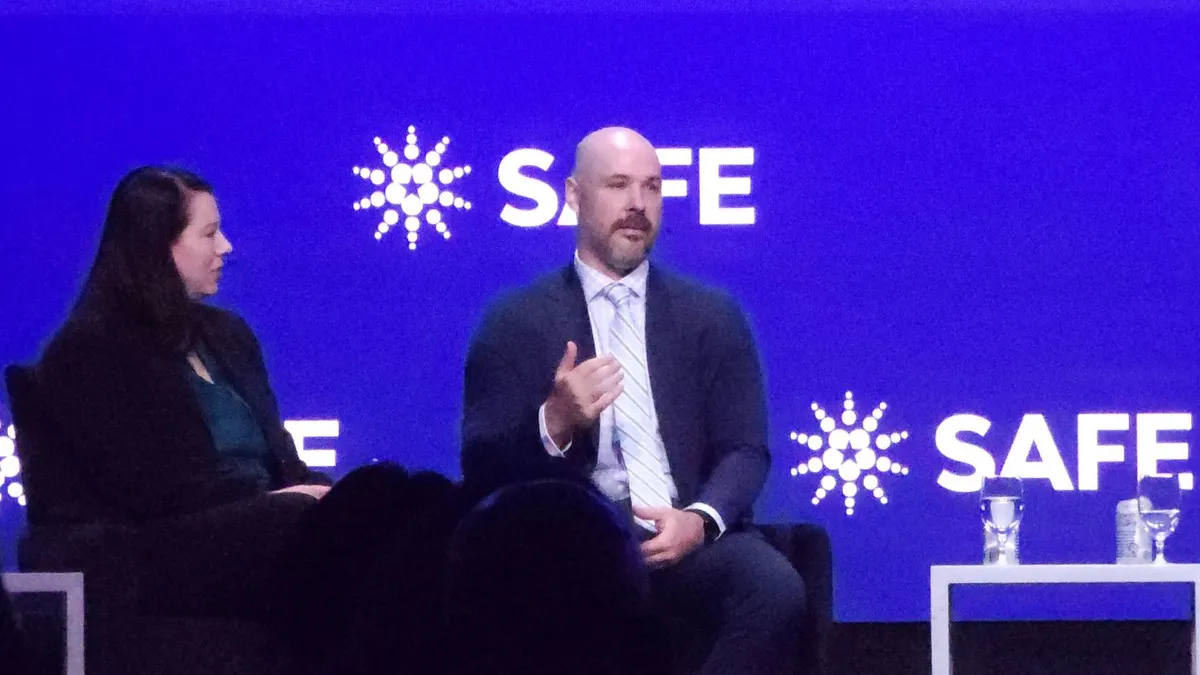
Executives from Lockheed Martin, Oerlikon Surface Solutions and e-Vac Magnetics discussed how they mitigate costs and addressed their concerns in procuring critical elements in the defense industrial base at the Safe Summit conference on Tuesday.
Samuel Stein, a critical materials engineer at Lockheed Martin, said the defense contractor doesn’t buy raw materials but purchases components made with raw materials incorporated into its systems.
However, the company had to “get creative” to mitigate the timing as it takes a while for them to receive the component. Thus, the company works with its sub-tier suppliers to coordinate timing and delivery.
“When a rare earth comes out of the ground, it doesn’t get onto an F-35 for two to three years,” Stein said.
Dattatraya Kamatkar, global head of sourcing at Oerlikon Surface Solutions, said the company has domestic suppliers for its products, such as thermal sprays used in jet engines and on turbine blades. Oerlikon’s issue is the procurement of rare earth minerals, particularly yttrium oxide, which the company uses to produce aerospace coatings. Last year, China imposed export restrictions on rare earth minerals, including yttrium oxide.
Thus, Oerlikon had to “get creative” as well for its sourcing, Kamatkar said. The company has a recycling stream in which they drill for rare-earth minerals while finishing the products. Oerlikon also works with the U.S. government in handling the upstream mineral process as well as U.S. suppliers in procuring yttrium oxide for uranium, titanium and chromium metals.
The challenge, Kamatkar said, is that it’s not enough.
“The customers are asking more and more, so we don't know exactly whether it is a real demand or everybody is impacted, so we need more,” Kamatkar said. “That’s a very key business.”
The process to take oxide and turn it into a metal is “a cost,” as the “margins tend to be leaner in those stages,” said Samuel Trinch, president at e-VacMagnetics. He added that stronger policies could help manufacturers extract and process critical materials.
Moreover, a production tax credit would be beneficial in bringing jobs back to North America and using materials predominantly from the U.S. or allied countries, to support “this really critical supply chain that we need to continue to build out.”