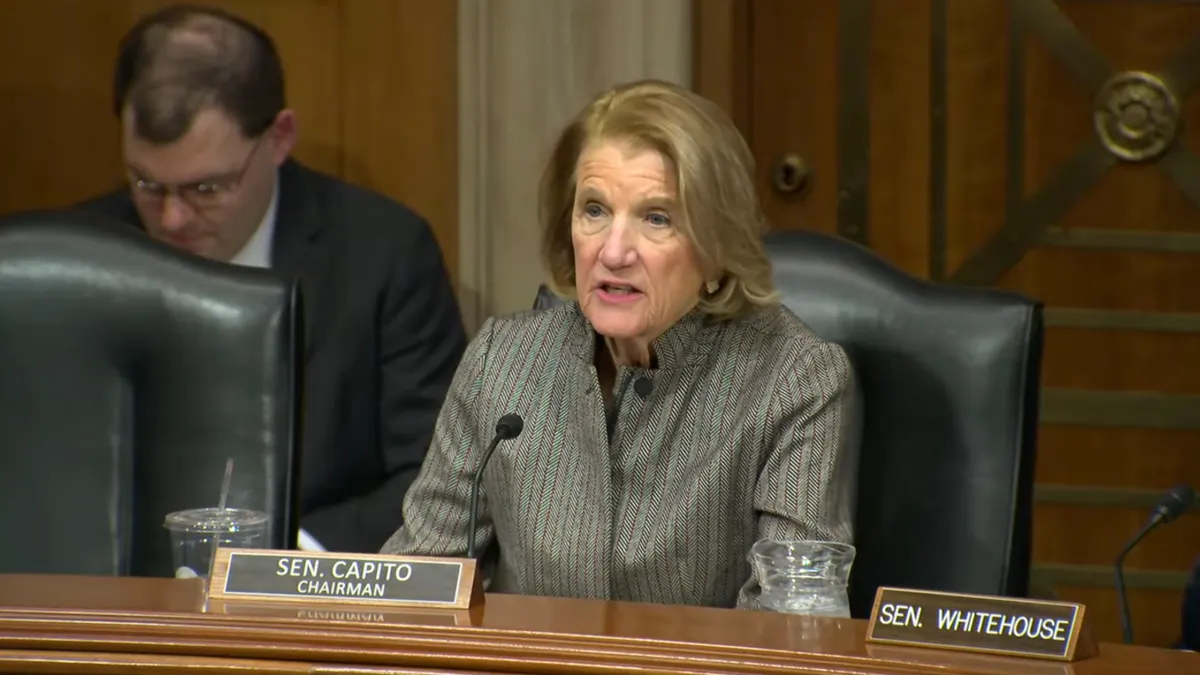
Industry and trade groups told the Senate Environment & Public Works Committee at a hearing Jan. 28 that Congress urgently needs to enact permitting reforms for faster approval of major infrastructure projects.
They said that streamlining the permitting process will lower business and consumer costs, reduce waste and uncertainty, help meet the country’s growing energy demand, and accomplish other important, longstanding industry priorities.
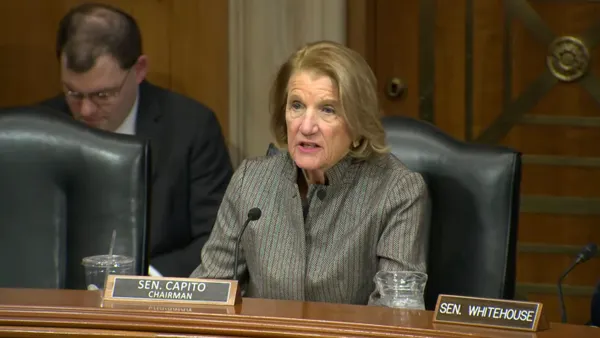
The existing regulatory structure “pits uncertainty and the misapplication and abuse of our laws against American prosperity,” Committee Chair Shelley Moore Capito, R-W.Va., said in her opening statement.
She said the committee seeks to approve permitting reform legislation that is bipartisan and project neutral, and creates predictability, consistency and finality in securing a permit. She also called for bringing accountability “to every stage of the permitting process, goes beyond the National Environmental Policy Act to address issues with core permitting laws and processes, and includes provisions that address judicial review of fully permitted projects.
Last month, the House passed bipartisan reforms to NEPA and the Clean Water Act, including permitting reforms, via the Standardizing Permitting and Expediting Economic Development Act. That bill was referred to the Senate on Dec. 18. 2025.
“It is now time for the Senate to act,” Capito said. Her committee held another hearing on permitting reform last year.
The National Association of Manufacturers and other manufacturing stakeholders also want to see permitting reform and support the House package.
Ranking Member Sen. Sheldon Whitehouse, D-R.I., said although both parties want to reform the permitting system, “there is a trust problem with the [Trump] administration’s behavior that would need to be solved.”
“Trump’s initial executive order declaring an energy emergency but not defining solar or wind even as energy was a bad and irrational start,” he said in his opening statement. He also criticized the administration's “unlawful and irrational blockade” of various offshore wind projects and other efforts to slow or stop energy projects, often based on purported national security concerns.
As a result, he said, permitting reform negotiations have stalled. “The Trump administration’s lawless, irrational, and unpredictable attacks loom over every industry. None of it is good for business. The nonsense must stop.”
He added that although he still wants to see bipartisan Senate permitting reform, it makes no sense to pass such a bill that will be “illegally butchered by a lawless executive branch.”
Shoring up supply chains, strengthening the workforce, and realizing returns
Brendan Bechtel, chairman and CEO of Bechtel, an engineering, procurement, construction and project management company, told the committee that permitting and litigation reform can “address critical minerals shortages and supply chain vulnerabilities, alleviate transmission constraints and remove other barriers to American economic success.”
Reforms that reduce uncertainty and delays will speed up hiring, strengthen domestic industries, and promote training and apprenticeship programs, he said.
Although some progress on permitting reform has been made, Bechtel said, major infrastructure project delays continue to result in unrealized returns of $100 billion to $140 billion per year.
“While the U.S. waits, other countries move ahead and capture market share. Nations with more predictable permitting systems are advancing large-scale infrastructure projects faster – particularly in strategic sectors that will define the future like nuclear energy, semiconductor manufacturing, and AI infrastructure.”
Bechtel said Congress should amend NEPA to limit reviews to environmental impacts not already within another federal agency’s direct regulatory jurisdiction. He also called for improving the litigation process for alleged NEPA violations. In addition, he said Congress should make reviews more efficient by utilizing nationwide permits and requiring agencies to use state data where states have primary regulatory authority over a project.
Protecting consumers
Dustin Meyer, senior vice president of policy, economics, and research at the American Petroleum Institute, agreed that the current federal permitting system unnecessarily delays infrastructure projects. This ultimately hurt consumers, he said,
“When infrastructure projects are delayed or constrained, costs go up and the system loses its ability to respond to market needs,” Meyer said. “Put simply, our current permitting system obstructs necessary infrastructure projects, and consumers pay the price.”
He noted that the U.S. has a history of swiftly approving major projects such as the Hoover Dam. However, similar projects today “would face years of sequential reviews, overlapping agency processes, cost escalation, uncertain litigation exposure, and the risk that permits could be revoked long after approval. The process has swung from disciplined decision-making to procedural paralysis.”
He emphasized that permitting reform is urgently needed to address the country’s growing energy demand stemming from data centers, reshoring initiatives, and other factors. In particular, he said unnecessary regulatory obstacles have hampered the oil and gas industry while doing little or nothing to protect the environment.
Meyer agreed with many of Bechtel’s proposed solutions, including reforming NEPA to include less onerous documentation and other requirements. He also called for changes to the Clean Water Act, such as extending the reauthorization period for nationwide permits under Section 404 from five to 10 years.
Boosting solar energy
The U.S. can now produce every major component of the solar and storage supply chain. However, Abigail Ross Hopper, the outgoing president and CEO of the Solar Energy Industries Association, said the Trump administration is throwing up unnecessary roadblocks that are keeping the U.S. solar industry from fulfilling its potential.
In particular, she stressed the need for energy and transmission project permits to be “considered in good faith” and treated equally regardless of the project or energy source.
“Unfortunately, the federal government’s current ad hoc permitting processes for solar projects lack credibility as agencies have damaged any certainty that they will treat fairly or even consider solar and battery storage applications,” she said.
For example, the U.S. Department of the Interior has “created 68 new layers of red tape amounting to a moratorium on solar energy, requiring political appointee and Secretarial level approval for even the most minor project review,” Hopper said. “Virtually all solar project applications are effectively disappearing in DOI, leaving most project developers in the dark as to whether the agency will ever consider their project.
She added that such measures are “threatening billions of dollars of investment at a time when demand for solar energy remains strong.” Hopper said that unlike many other industry groups, her organization cannot support the SPEED Act because it does not ensure that federal agencies will fairly consider reviews and applications for solar projects.
Brent Booker, general president of the Laborers' International Union of North America, and David Terry, President of the National Association of State Energy Officials, also testified at the hearing.