
Dive Brief:
- Ford Motor Co. and battery maker SK On have reached a mutual agreement to dissolve their electric vehicle battery joint venture BlueOval SK, SK Americas spokesperson Joe Guy Collier confirmed in an email to WardsAuto.
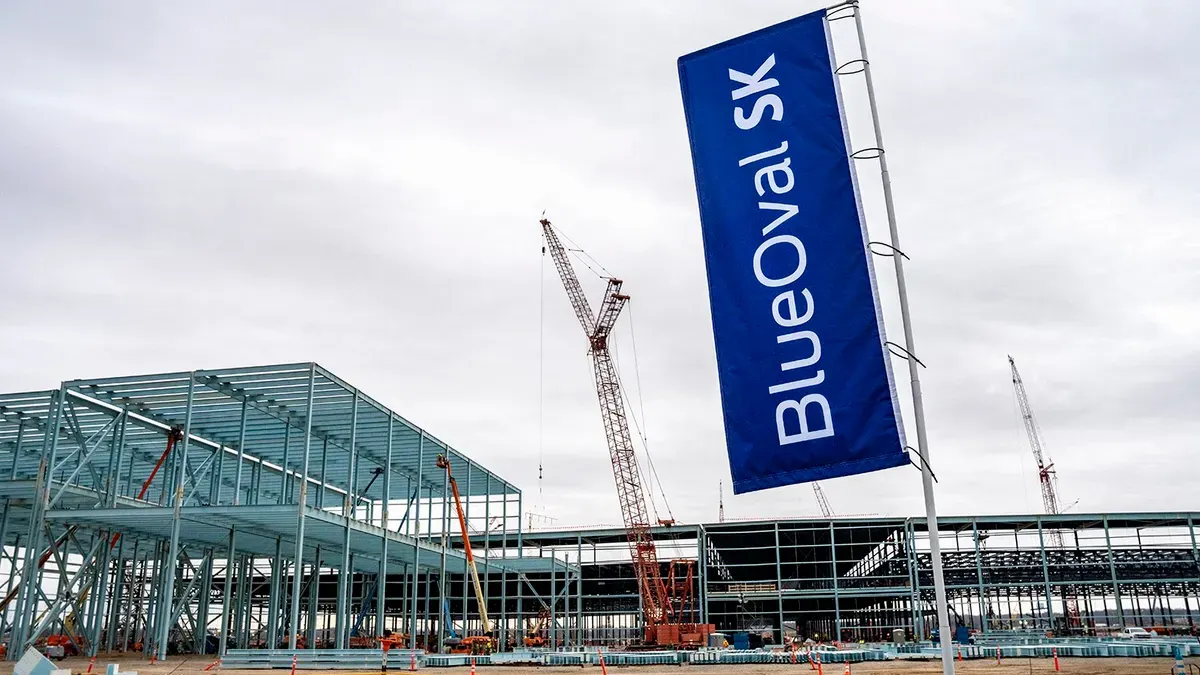
- The joint venture was established in September 2021 as part of a planned $11.4 billion investment by the two companies to build three large-scale manufacturing plants — one in Tennessee and two in Kentucky — to produce advanced batteries for Ford’s future EVs.
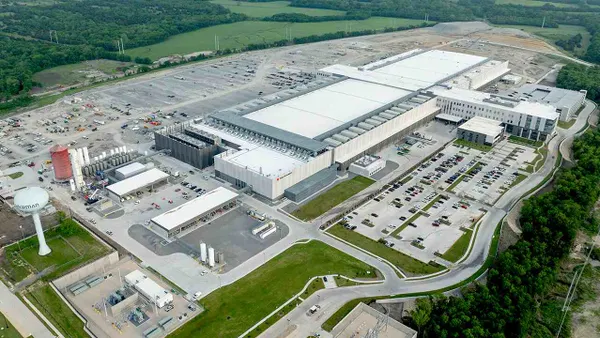
- Under the terms of the dissolution agreement, each company will independently own and operate the joint venture’s former production facilities, Collier said. A Ford subsidiary will take full ownership of the two battery plants in Kentucky, and SK On will assume full ownership and operate the battery plant in Tennessee.
Dive Insight:
Although SK On will own and operate the battery manufacturing facility in Tennessee, the company will maintain its strategic partnership with Ford and continue to supply EV batteries for its future vehicles, according to Collier.
“SK On is committed to the Tennessee plant long-term. We plan to make it a key part of our manufacturing base for advanced batteries in the U.S.,” the company said in a statement.
However, going forward, SK On plans to focus more on “profitable and sustainable growth” in the U.S. by supplying batteries produced in the Tennessee plant to other customers, including for stationary energy storage systems, the company said.
“This agreement allows SK On to strategically realign assets and production capacity to improve its operational efficiency,” the battery maker said in a statement. “It also enables the company to enhance productivity, operational flexibility, and respond more effectively to evolving market dynamics and diverse customer needs.”
Ford and SK On's planned $11.4 billion investment in BlueOval SK announced in September 2021 was the largest-ever manufacturing commitment in the company's history, the automaker said at the time. BlueOval SK officially broke ground on its battery manufacturing campus in Kentucky in December 2022.
In December 2024, the Department of Energy announced the closing of a $9.6 billion direct loan to BlueOval SK. The funds were earmarked for the construction of the three U.S. plants. The loan was also the largest-ever granted by the DOE’s Advanced Technology Vehicles Manufacturing Loan Program, which was designed to increase domestic production of EVs and related components to boost U.S. competitiveness in the global auto market.
But amid declining EV sales and the ending of the federal EV tax credit of up to $7,500 on Sept. 30, Ford currently does not require the additional battery production capacity it originally had anticipated.
The BlueOval SK Battery Park in Kentucky was originally slated to begin production of advanced lithium-ion batteries this year. But Ford announced plans last year to delay its EV launches in order to expand its hybrid vehicle offerings and the planned production start was pushed forward to 2026.
Despite the billions of dollars of investments in electrification, Ford has yet to make a profit selling EVs. The automaker’s Model e EV division lost $5.1 billion in 2024, which followed a loss of $4.7 billion in 2023. The division is still losing money in 2025. In Q1, Ford reported an EBIT loss of $849 million on $1.2 billion in revenue for its Model e division.
Still, Ford announced another $5 billion investment in electrification this summer, including $2 billion to modernize its Louisville, Ky. plant for the production of a new, more affordable electric pickup.
The dissolution of the joint venture also comes after President Donald Trump announced plans last week to rollback Corporate Average Fuel Economy (CAFE) standards put in place by the former Biden Administration that would have required automakers to achieve average fuel economy of 50.4 miles a gallon by 2031.
The plans were announced at a White House event that was attended by Ford CEO Jim Farley, who expressed his support for the plan. The automaker currently counts on the sales of fullsize gas-powered trucks and SUVs for a majority of its profits.
In October 2024, Ford announced a separate battery supply deal with LG Energy Solution for the European market. The terms of the agreement included supplying Ford with an estimated 109 gigawatt hours of batteries for its commercial EVs beginning in 2026. Also as part of the deal, Ford said it would relocate battery production for the electric Mustang Mach-E from LG’s factory in Poland to its U.S. facility in Michigan by this year.
General Motors also announced plans in October to scale back EV battery production amid slowing demand, which included cutting thousands of jobs. The automaker said it anticipates that production at its Ohio and Tennessee Ultium Cell battery plants will resume by mid-2026.
The dissolution of BlueOval SK is still subject to customary regulatory approvals and other closing conditions, but it’s expected to be finalized in the first quarter of 2026, according to SK On.