Manufacturers are looking to leverage artificial intelligence-powered robots and technologies to enhance their operations and improve efficiencies.
Here are some notable physical AI-related updates from May.
Fanuc, Google team-up on factory robots
Industrial robot maker Fanuc has partnered with Google to deliver “smarter, more adaptive robots” for manufacturers, the companies said May 19.
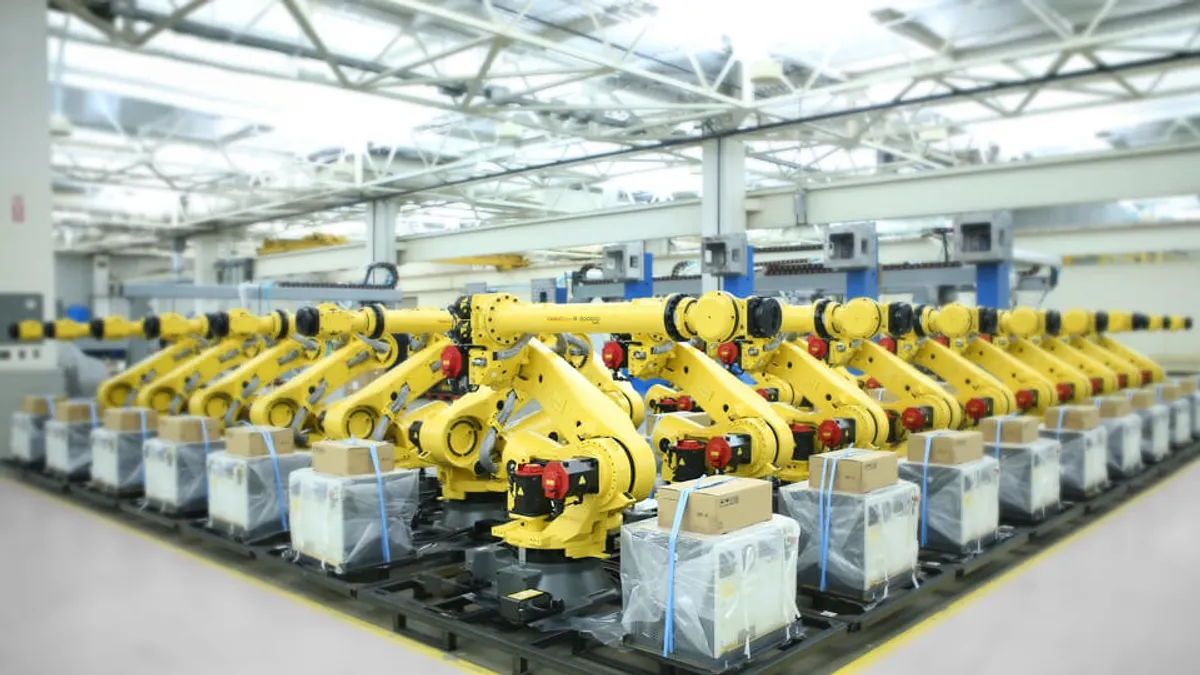
As part of the collaboration, Fanuc is leveraging Google’s technologies and advancing its open platforms by applying the latest AI across its robotics lineup, according to a news release. The robots vary from smaller models with three-kilogram payloads to larger ones that can carry multiple tons.
Fanuc’s robots support Robot Operating System, an industry standard platform for robot control, through its open-source ROS drivers. Google is a key contributor to ROS through Intrinsic, a robotics AI group. Fanuc said the open-platform capabilities allow manufacturers to “seamlessly deploy” physical AI robot systems with the latest technologies on the factory floor.
“By combining Fanuc’s industrial-grade robotics with Google’s advanced AI, we’re enabling customers to take on more complex, variable production while maintaining the reliability and performance that production environments demand,” Mike Cicco, president and CEO of Fanuc America, said in a statement.
Fanuc has shipped more than 1,000 robots for physical AI-related applications since releasing its systems at the International Robot Exhibition in Tokyo in December.
Kawasaki opens physical AI center in Silicon Valley
Kawasaki Heavy Industries has opened its physical AI center in San Jose, California, in an effort to advance AI and semiconductor development and collaboration between the U.S. and Japan.
Kawasaki CEO Yasuhiko Hashimoto said that he hopes the Silicon Valley center will be a starting point for global partnerships with industry leaders and academia in the region.
The company plans to initially work with Nvidia, Analog Devices, Microsoft and Fujitsu to develop physical AI solutions with real-world applications in the healthcare and mobility sectors. Kawasaki held an opening ceremony on May 21.
“We will first focus on healthcare and elder care, where aging societies and labor shortages are global challenges,” Hashimoto said at the ceremony. Kawasaki will also deploy “integrated solutions across diverse fields” by expanding its physical AI and robotics across semiconductors, automotive and new mobility, he added.
Through its external partnerships, Kawasaki plans to develop new solutions and combine physical AI with existing robotics, such as its surgical and indoor delivery systems.
The company said its San Jose center will collaborate with other Kawasaki bases in Japan, as well as its research and development innovation center that opened in March in Strasbourg, France.
“What we aim for is not to replace people, but to deliver physical AI that supports human judgement and action safely and efficiently,” Hashimoto said in his remarks.
Stellantis to pilot digital twins in North America
Automaker Stellantis said it plans to integrate AI-driven digital twins across its global manufacturing footprint with help from Accenture and Nvidia.
The move is part of Stellantis’ strategy to build more “adaptive, efficient, and resilient production systems” through intelligent manufacturing, according to a news release.
The Jeep and Chrysler owner is using “high-fidelity virtual plant replicas” to validate processes before physical deployment, enhance quality through predictive monitoring and reduce risk across its operations.
“By combining digital twins, AI and advanced simulation, we are rethinking how we design, operate and continuously improve our production systems,” Francesco Ciancia, head of manufacturing at Stellantis, said in a statement. “This initiative is designed to work hand in hand with our teams, enhancing their ability to anticipate issues, enabling faster decisions and continuous improvement.”
Initial digital twin deployments are scheduled this year at select North American plants. Stellantis said it will continue to assess and evolve this effort in collaboration with Accenture and Nvidia. Together, the companies plan to explore how AI-driven digital twins can enable “closed-loop optimization,” where virtual and physical manufacturing systems can continuously inform and improve each other.