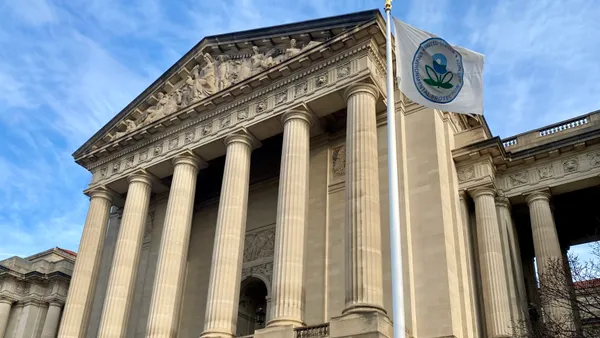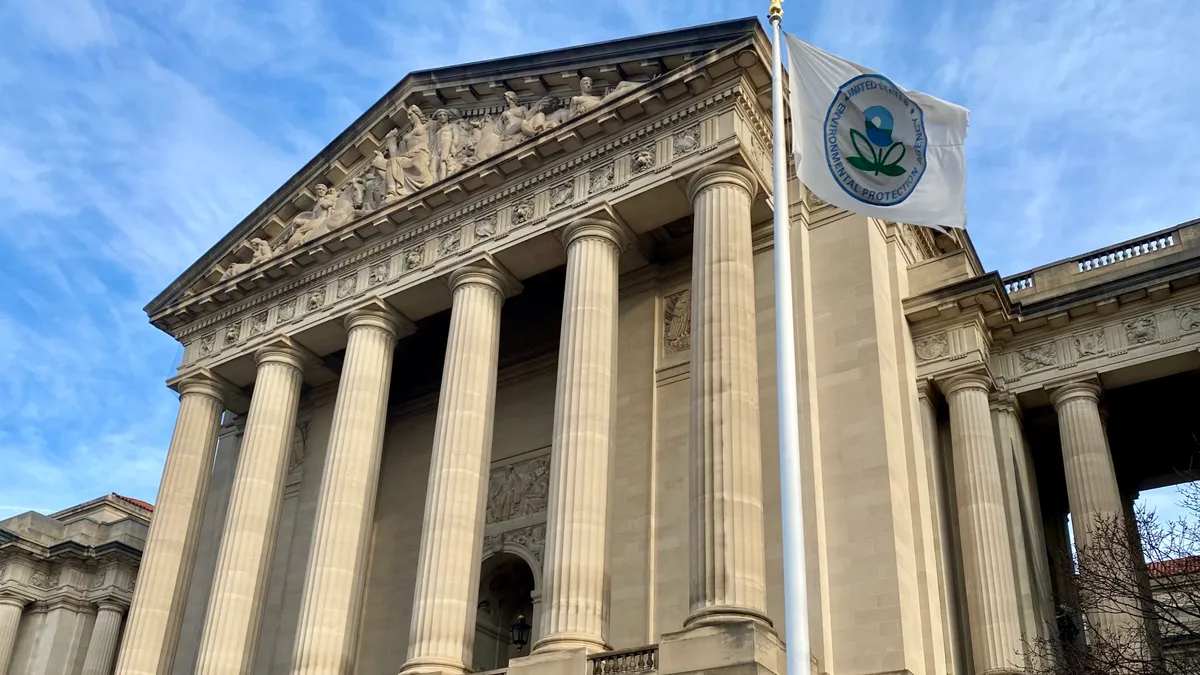
The Trump administration is moving closer to reworking a Biden-era standard for fine particulate matter that manufacturers have criticized as unachievable.
The U.S. EPA rule, which was finalized in March of 2024 and went into effect May 6 of that year, lowered the annual limit for PM 2.5 from 12 micrograms per cubic meter of air to nine.
The new standard was intended to “protect public health with an adequate margin of safety” in accordance with the Clean Air Act, based on mounting scientific evidence showing that long-term exposure to PM 2.5 causes premature death and increases the risk of heart attacks, strokes, and respiratory problems, the new rule noted. The EPA estimated at the time that the change could prevent 4,500 premature deaths and 290,000 lost workdays and yield $22 billion to $46 billion in benefits, while incurring an estimated $590 million in costs by 2032.
The agency kept in place the existing 24-hour PM 2.5 standard of 35 micrograms per cubic meter of air. That limit measures levels over a shorter time frame than the annual standard.
Industry groups warned that the stricter annual limit would force a wide range of key manufacturing industries — including cement makers, chemical manufacturers, steel mills, coal-fired power plants and battery manufacturers — to pull back on construction of new factories in many areas and would hurt the economy.
Last March, just after President Donald Trump began his second term, the EPA announced it would revisit the PM 2.5 rule, along with 30 other environmental regulations. In an agency video, Administrator Lee Zeldin said the rules need to be reworked to ease costs for businesses and “give power back to the states.” Several industry groups also challenged the Biden rule in court.
Last November, EPA attorneys filed a motion asking the US Court of Appeals for the District of Columbia Circuit to vacate the standard. The Biden administration, they said, had taken a “regulatory shortcut” in adopting the tighter limit and did not conduct a thorough enough review. Biden’s EPA also failed to adequately consider the cost of complying with the new limit, the motion said.
Environmental groups, including the Clean Air Task Force, disputed those claims, noting that the Supreme Court has found that the Clean Air Act prohibits EPA from considering implementation costs when setting or revising National Ambient Air Quality Standards.
“An abundance of scientific evidence shows going back to the previous standard would fail to provide the level of protection for public health required under the Clean Air Act, and, regardless of what EPA does, CATF will continue to defend this important rule in court,” Hayden Hashimoto, an attorney with the group, said in a statement issued after the EPA filed the motion to vacate.
California and several other states intervened to challenge the EPA’s motion, suggesting in a Dec. 16 filing that the agency had delayed revising the limit in hopes that the courts would strike down the rule.
States across the country have joined the legal fight over the new limit.
Twenty-four states — including Alabama, Florida, Kentucky, Louisiana, Montana, West Virginia and Wyoming — joined industry groups in challenging the rule in March 2024. Weeks later, 16 states — including Arizona, California, Maryland, Oregon and Wisconsin, as well as the District of Columbia and New York City — filed a motion to intervene to uphold the tighter limit, along with environmental groups.
In a legal filing in November, EPA urged the court to vacate the rule before the initial determination of which areas do not meet the new standard is due on Feb. 7. EPA Press Secretary Carolyn Holran declined to comment on the status of the effort to retool the rule. In an emailed statement, she said the Biden-era PM 2.5 standard “has raised serious concerns from states across the country and served as a major obstacle to permitting.”
Implementation plans from the states, which are charged with enacting and enforcing air quality standards, are due in April. Asked if the agency will uphold the Biden rule while retooling it, Holran said in an email that “EPA will always follow the law as we Power the Great American Comeback while carrying out our core mission of protecting human health and the environment.”
Manufacturers push for reverting to previous standard
The EPA’s move to revisit the rule has received praise from the National Association of Manufacturers and other industry groups, which have projected that the stricter standard would throw counties into non-attainment status that are home to 40% of the U.S. population, making it difficult to secure permits for new factories and other projects.
That would curtail manufacturing of a wide range of products, including the cement and steel needed for new US infrastructure, the groups said. The EPA had estimated in 2024 that most counties already meet the nine micrograms per cubic meter standard and that 99% of U.S. counties would do so by 2032.
The updated PM 2.5 standard was “one of the things we were most concerned about” during the Biden administration, said Brandon Farris, executive vice president of the Steel Manufacturers Association and former vice president of energy and resources policy at NAM.
“If you’re putting a shovel in the dirt anywhere, or you’re building a new manufacturing facility or operating your current ones or trying to do any upgrades, then the particulate matter is going to be one of the most burdensome rules,” he said.
Most companies could meet the previous standard of 12 micrograms per cubic meter or find a way to offset those emissions, but nine micrograms doesn’t allow for much headroom given existing background levels, Farris said.
“It’s pretty darn close to nine, just without manufacturing, in a lot of areas of the country,” he said. “I truly don't know of many areas in the country that would be able to meet a standard of nine and allow for any growth.”
The tighter standard also places an unfair burden on manufacturing, which only accounts for 12% of PM 2.5 pollution, he added. “It’s wildfires, it’s dust storms, it’s unpaved roads,” Farris said. “This new standard essentially punishes manufacturing, [even though] manufacturing isn’t the largest source of this.”
SMA was one of 15 industry groups, including the Aluminum Association, the American Forest & Paper Association, and the American Fuel & Petrochemicals Manufacturers that signed a Jan. 6 letter urging the Trump administration to take “prompt action to correct an unlawful rule.” Members of the groups are already considering scaling back or relocating projects due to the revised standard, according to the letter.
Sean O’Neill, the American Cement Association’s senior vice president for government affairs, said he wasn’t aware of any specific projects in his industry that have been affected by the new standard yet. But he said the uncertainty around the future of the rule has made it difficult to plan future investments.
“We’re hopeful that this will be overturned,” he said. “If the standard was put back to where it was, I think you could see more capital investment occurring ... but it’s just a challenging time right now.”
AMA projects the lower standard could reduce domestic cement production, leading to layoffs and greater dependence on foreign imports. “We continue to be efficient at the plants, we continue to be innovative, but you can only do so much,” said O’Neill.
A 2025 report by the American Cement Association, one of the industry groups that initially filed suit against the lower limit, estimated that the U.S. will need 1 million metric tons of cement just to build the data centers needed to run artificial intelligence. By 2027, the number of data centers in the U.S. is expected to increase from 5,426 to 6,000, according to the report.
Vehicle rules revisited
Other air quality rules are getting a second look as well.
Aaron Szabo, EPA’s assistant administrator for the office of air and radiation, said in a Dec. 19 op-ed that the agency will move forward in early 2026 with plans to revisit two regulations aimed at cutting nitrogen oxide emissions from vehicles. Auto manufacturers opposed both rules, including a 2024 rule for light and medium-duty vehicles of model years 2027 and later, and a 2022 rule targeting heavy-duty vehicles.
Health advocacy groups warn that rolling back the new, stricter NAAQS for PM 2.5 and vehicle emissions favors industry at the expense of public health.
On Jan. 14, 75 groups and municipalities, including the Environmental Defense Fund, Clean Air Task Force, the City of Portland, Ore., and the Respiratory Health Association, sent a letter to the EPA opposing the overhaul of the vehicle standards.
They warned that tailpipe emissions remain “a significant source” of nitrogen oxides, non-methane organic gas, volatile organic compounds and particulate matter. The group’s letter said “any rollback would lead directly to increased hospitalization rates, lost work and school days, and thousands of preventable deaths.” Weakening the rules would also make it more difficult for states to achieve the NAAQS for PM 2.5 and ozone, they added.
As Trump’s EPA reassesses air quality standards adopted by the Biden administration, the agency is also likely to calculate costs and benefits differently than in the past.
The EPA recently announced it will no longer determine a dollar value for health benefits when changing regulations for PM 2.5 and ozone, such as the number of premature deaths, asthma attacks and other health problems avoided, saying the modeling used to produce those estimates is not robust enough. But the EPA “will still be considering lives saved when setting pollution limits," Administrator Zeldin posted to X on Jan. 12.