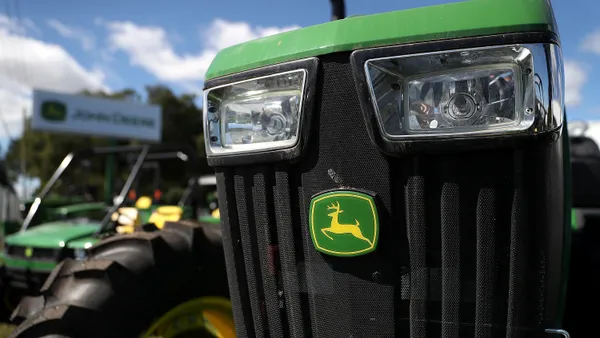
Tractor giants are continuing to ride out the slow demand cycle as farmers face high costs and low commodity prices. Companies with strong U.S. customer bases, such as Deere, CNH and Agco, have been deliberately underproducing, destocking inventories and navigating dynamic trade fluctuations.
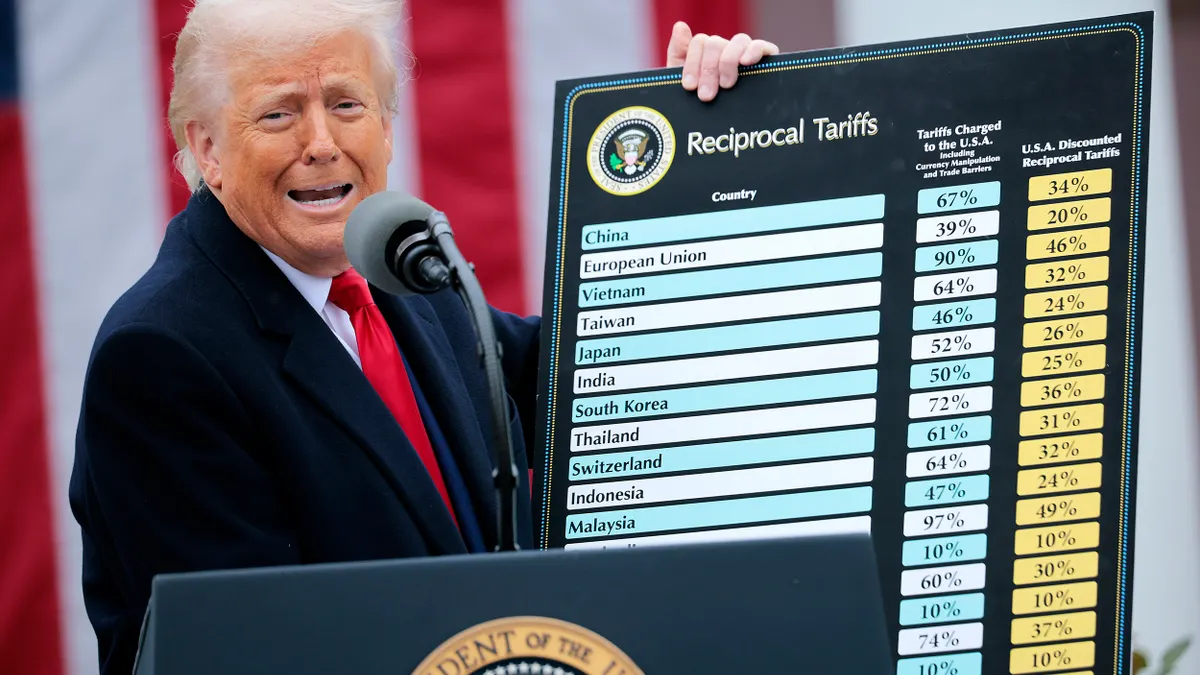
Conditions may be changing, however, after the U.S. Supreme Court’s ruling on Friday to nullify a significant portion of the president’s tariffs.
Here are some of the highlights from the companies’ latest earnings reports.
Tariff pivots following Supreme Court decision
Deere & Co. and other manufacturers could seek hundreds of millions of dollars in tariff relief following the Supreme Court’s ruling.
Deere, based in Moline, Illinois, estimated its 2026 tariff costs to be $1.2 billion pre-tax, the company’s director of investor relations Josh Beal said in an earnings call Feb. Less than half of the total is from tariffs under the International Emergency Economic Powers Act, he said. The Supreme Court overturned President Donald Trump’s sweeping use of the authority the following day.
“It’s hard to say if those go away or something else doesn’t come back,” Beal said. “We won’t react too quickly. Similar to when we saw tariffs going up last year, we didn’t take immediate price action.”
Over the past year, Deere and other tractor makers have switched suppliers, increased prices and taken other actions to mitigate the effects of tariffs under IEEPA and Section 232 of the Trade Expansion Act. The latter authority was unaffected by the court’s decision. Shortly after, Trump moved to enact 10% tariffs under Section 122 of the Trade Act of 1974 for a period of 150 days.
“We’ll see how the environment changes,” Deere SVP and CFO Josh Jepsen said on the call. “But we’re going to keep working on that and focus on the things that we can manage.”
Agco, a Georgia-based maker of Fendt and Massey Ferguson brands, estimated its 2026 tariff costs to be between $105 million to $110 million as it looks to navigate dynamic policies. The company did not disclose a breakdown of its tariff exposure by authority.
“We will adjust our outlook if policy actions change,” Damon Audia, Agco’s SVP and CFO said in an earnings call on Feb. 5.
Destocking efforts slow as underproduction continues
To better align with customer demand, tractor makers are continuing to adjust production and destock inventory. CNH, a U.K.-based maker of Case and New Holland brands, will continue to produce at low levels in the current quarter, CFO James Nickolas said in an earnings call Feb. 17. Approximately 40% of the company’s 2024 net sales came from North America.
“We will still be underproducing to the retail demand in order to reach our dealer inventory targets,” Nickolas said.
CNH is also slowing its dealer destocking efforts. CEO Gerrit Marx said the majority of the company’s dealer destocking, a strategy to reduce inventory levels to free up cash and reduce storage costs, happened over the past two years.
This year is about “fine-tuning” by product lines and markets, Marx said, describing the current quarter as “the last innings of that journey.”
Meanwhile, Deere executives said they believe the company is well positioned for a demand upturn after a period of underproduction last year. Beal said large tractor orders have picked up in North American markets. He said Deere also feels good about its inventory levels domestically, as well as in Europe and South America.
“We underproduced retail in the first half of fiscal 2025, which set us up to produce in line with demand this year,” he said.
Agco, however, is bracing for lower sales in the coming quarters from North America. Audia said the company will be underproducing relative to retail in the first half of 2026, in part from large agricultural market declines.
“We’ll see Q1 and Q2 will likely be worse than Q1 and Q2 of last year,” Audia said. “Hopefully, we’ll start to see the margins improve year-over-year, but still be down in Q3, which is likely a negative for the full year.”
Mixed 2026 outlooks as pressures continue
As farmers continue to face challenging market conditions, including high input costs and low commodity prices, tractor makers are revising their outlooks accordingly.
CNH reported that its 2026 agriculture segment sales will be down 5% to flat YoY as the company pursues cost efficiencies and manages rapid changes in trade policies. Its construction segment sales are also expected to be flat. The company posted full-year revenue of $18.1 billion in 2025, down 9% from the previous year.
“Commodity prices remain low, below farmers’ breakeven point, and they want more confidence in their end markets before making equipment purchases,” Nickolas said on the call.
Agco reported its 2026 sales to be higher than the previous year at a range between $10.4 billion to $10.7 billion, despite lower estimated sales from North America. Audia said Agco forecasts the region’s large agricultural sales to be down 15% from the low levels of 2025.
While the U.S. government’s $12 billion Farmer Bridge Assistance program is helping to shore up balance sheets, Audia said this has “not translated into new equipment purchases at this time.” He also noted that positive economic conditions in Europe and Brazil will likely offset the headwinds from North America.
Deere is also expecting the large agricultural equipment industry in the United States and Canada to fall 15% to 20% this year. However, Christopher Seibert, Deere’s manager of investor communications, said on the call that the company is seeing “encouraging developments” that could provide near-term stability in the segment.
“Ongoing improvement in the used inventory market is providing a better environment for machine replacement, while the age of the fleet continues to grow,” Seibert said. He also noted that proposed government policy actions, such as support for biofuels, could provide tailwinds for growth.
Deere reported its 2026 sales outlook to be down 5% to 10% for its production and production and precision agriculture segments. It estimated its construction and small agriculture and turf segments to be up 15% over the previous year.
“The developments over the course of the past three months have strengthened our belief that 2026 marks the bottom of the current cycle,” Seibert said.