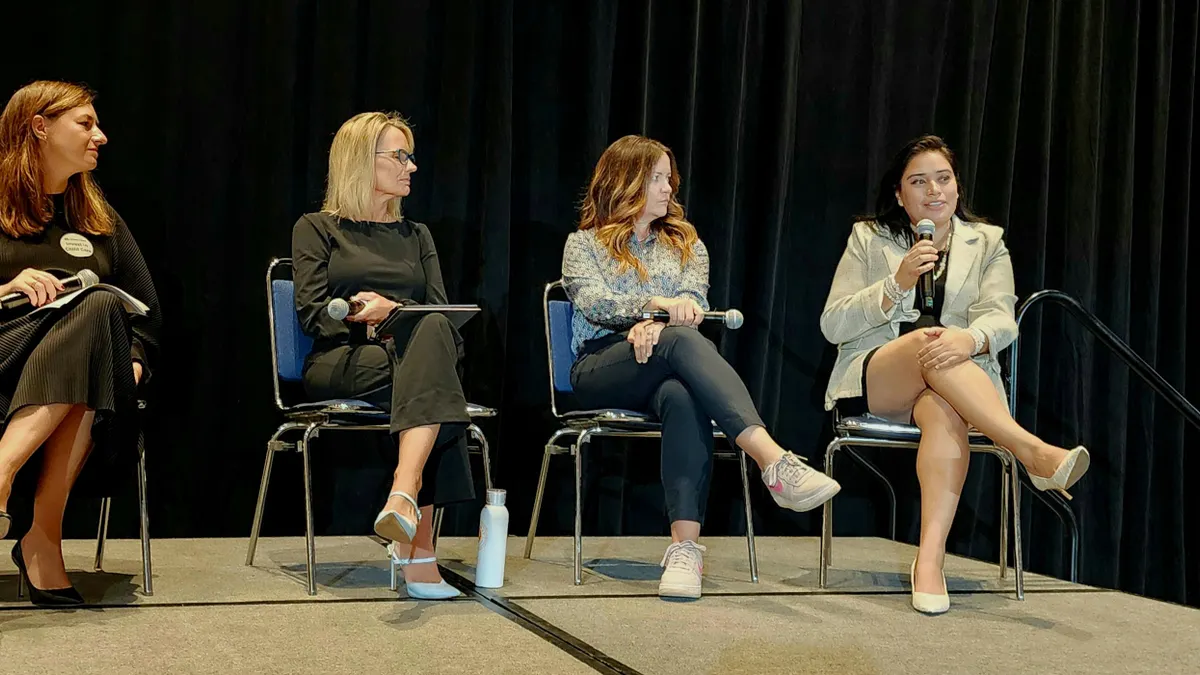
At the beginning of a panel discussion at the Women in Manufacturing Summit in October, Meredith Lipnick, director of private sector strategy at advocacy nonprofit Moms First, asked the audience a few questions.
She asked attendees to raise their hands if they had ever had to miss all or part of a workday to take a loved one to a doctor’s appointment, had to change their schedule because child care arrangements fell through, felt that their work life was in tension with their home life when arranging care, or all of the above.
About three-quarters of the room raised their hands, Lipnick noted.
Women are underrepresented in the manufacturing industry, comprising about 29% of the workforce, according to a 2022 report by Deloitte and The Manufacturing Institute.
That same year, The Manufacturing Institute launched the “35×30” campaign, which aims to close the gender gap by adding about 500,000 women to the industry by 2030. That would increase women’s representation to 35%.
One of the ways the industry could achieve its goal is through flexible work schedules, “attractive” income and benefits, and work-life balance, according to the report.
“If we all work together and uplift these issues, we can really change the conversation from, ‘This is a personal problem for families to solve,’ to ‘This is a systemic issue that the public and private sector can come together to find solutions for,’” Lipnick added.
Child care tax incentive to expand
Starting Jan. 1, 2026, an existing federal child care tax incentive will expand eligibility for expenses, including third-party mediators contracted with child care facilities and facilities jointly owned by companies.
The credit rate for expenditures will rise to 50% and 60% for small businesses.
Tax incentive 45F, included in the One Big Beautiful Bill Act signed over the summer, increased the maximum credit to $500,000. For small businesses, it’s $600,000.
In 2025, the 45F credit allowed businesses to reduce their income tax liability by up to $150,000 a year. The credit accounts for 25% of qualified child care expenses plus 10% of child care resource and referral services costs that the business incurred.
Moms First and Kindercare advocated for the changes to the policy.
Kimberly Spriggs, partnerships manager at Kindercare, said the company always hears from executives saying they know they need child care, but the biggest barrier is affordability.
“What we hear is, ‘Wow, love it. But we can’t really justify the costs at this point,’” Spriggs said. “So with the 45F child care credit now increasing, where the government is going to pay almost half of the cost, the math is going to work now for our companies.”
With 2026 right around the corner, Spriggs said now’s the time for businesses to start building partnerships in child care.
“Start developing a plan, make sure they know the needs of their workforce and get it moving, because it is a really big financial opportunity for corporations,” Spriggs said.
How child care ‘pays for itself’
According to a 2024 report by Moms First and Boston Consulting Group, inadequate child care has cost employers $13 billion a year in lost productivity. Furthermore, it can cost companies up to twice an employee’s salary to replace a worker.
In 2022, Moms First launched the National Business Coalition for Child Care, which organizes employers to expand workplace policies and advocate for child care as an economic obligation to help change legislation, according to its website.
Since then, the coalition has grown to more than 200 members, including manufacturing companies Intel, L’Oreal, Estée Lauder, Chobani, Micron Technology and Merck.
“We really think that the private sector has a really important role to play, not only because caregiving is so important, but because there’s a real bottom line,” Lipnick said. “There’s a real return on investment.”
Child care improves recruitment and retention
Moms First and BCG’s 2024 report included financial analysis, personal interviews, and survey responses from nearly 1,000 U.S.-based employees at five companies that have child care benefits: Etsy, Fast Retailing, Steamboat Ski Resort, Synchrony and UPS.
The report found that these five companies achieved returns on investment of up to 425%. Additionally, 90% of employers said child care benefits boosted talent recruitment and retention, and 88% agreed that child care benefits increased productivity.
On the employee side, up to 86% of working parents said they’re more likely to stay with their employer and up to 78% reported positive career impacts. Furthermore, working parents avoided up to 16 days of work per year.
“That was really an unlock for us in thinking about why this is so important, not just from a family perspective, but an economic perspective,” Lipnick said.
Sara McLeod, head of global compensation at Whirlpool, said that the company’s recruitment and retention have drastically improved since establishing an on-site child care center at its headquarters in Benton Township, Michigan.
Dubbed The Eddy, a synonym for whirlpool, the center opened in 2019 and is operated in partnership with KinderCare.
McLeod said Whirlpool employees who have children at The Eddy are more engaged and have an “extremely higher retention rate.” The company also hears a lot from its global talent pool that The Eddy was their final decision maker.
“They knew that was one less thing that they had to think about when they were relocating to Southwest Michigan, [which] was where their children were going to be and how safe they were going to be,” McLeod said.
The appliance manufacturer often doesn’t see employees leave Whirlpool until their children are done with The Eddy, she added.
A problem to be solved
For manufacturing plant workers, especially those in facilities across the country, child care isn’t easy to find or afford. Moreover, factory employees work shifts before and after business hours.
Kindercare takes a look at the manufacturing site’s scheduling and assesses the needs as part of developing the plan, followed by a survey to determine the “right kind” of operating hours, Sprigg said.
Whirlpool has 10 manufacturing facilities across the United States, but The Eddy is only at the company’s headquarters. McLeod said Whirlpool is still trying to find a solution, as it loses attendance due to child care issues. In the meantime, the company has discounted rates for Kindercares nationwide that their employees can use.
“But I would say that’s a problem that I think we as women in manufacturing need to solve,” McLeod said.