Dive Brief:
- Boeing’s full-year revenue increased 34% to $89.5 billion, reflecting “improved operational performance” across the plane manufacturer’s business, CFO Jay Malave said in an earnings call on Tuesday.
- Revenue for Boeing’s fourth quarter leaped 57% year over year to approximately $24 billion, driven by higher commercial aircraft deliveries and defense volume, Malave said.
- Looking ahead, the company expects free cash flow of $1 billion to $3 billion, in line with its forecast of increased deliveries in 2026, particularly for its 737 and 787 models, the CFO noted in remarks he made at a conference last month.
Dive Insight:
Other factors that could lead to cash flow include improving performance at Boeing’s defense, space and security sector as well as continuing growth at its global services division, Malave added.
The company has been focused on reducing the defense, space and security business’s risk profile of its development programs, Kelly Ortberg, president and CEO, said on the call.
“Across commercial, defense and services, we’ve built a strong foundation for the year ahead,” Ortberg said. “And while I’m proud of what we accomplished in 2025, we also know expectations are rising, and we must continue to elevate the performance that we've demonstrated over this past 12 months.”
Despite the positive outlook, Malave added Boeing’s Q1 free cash flow will be used in the first half of the year due to several impacts the company expects will be temporary and improve over time. Boeing spent $1.9 billion in 2025, but Malave said the company expects to spend nearly $4 billion in 2026.
The expense for the new year includes roughly $1 billion associated with the incorporation of Spirit AeroSystems, following Boeing’s acquisition in December 2025. Ortberg said in the call that bringing the two companies together strengthened Boeing’s efforts to improve safety and quality throughout its factories, operations and supply chain.
“There’s a lot of work ahead of us with an integration of this magnitude, and we have thoughtful, detailed plans in place to help enable a smooth transition for our new teammates while maintaining continuity for our customers and suppliers,” Ortberg added.
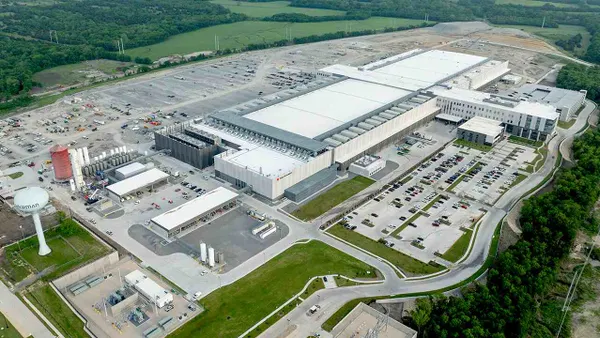
Other significant capital expenditures in Boeing’s outlook include spending on future products and growth, particularly at its defense jet and weapons site in St. Louis, and 787 Dreamliner site in Charleston, South Carolina. In May 2023, the company began construction on an advanced coatings center in the St. Louis area. The $1.8 billion facility will be operated under Phantom Works, part of Boeing defense, space and security’s proprietary research, development and prototyping division. Construction on the facility is expected to be complete in multiple phases between 2026 and 2030.
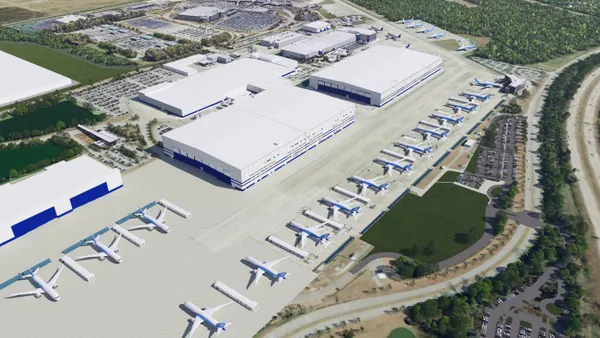
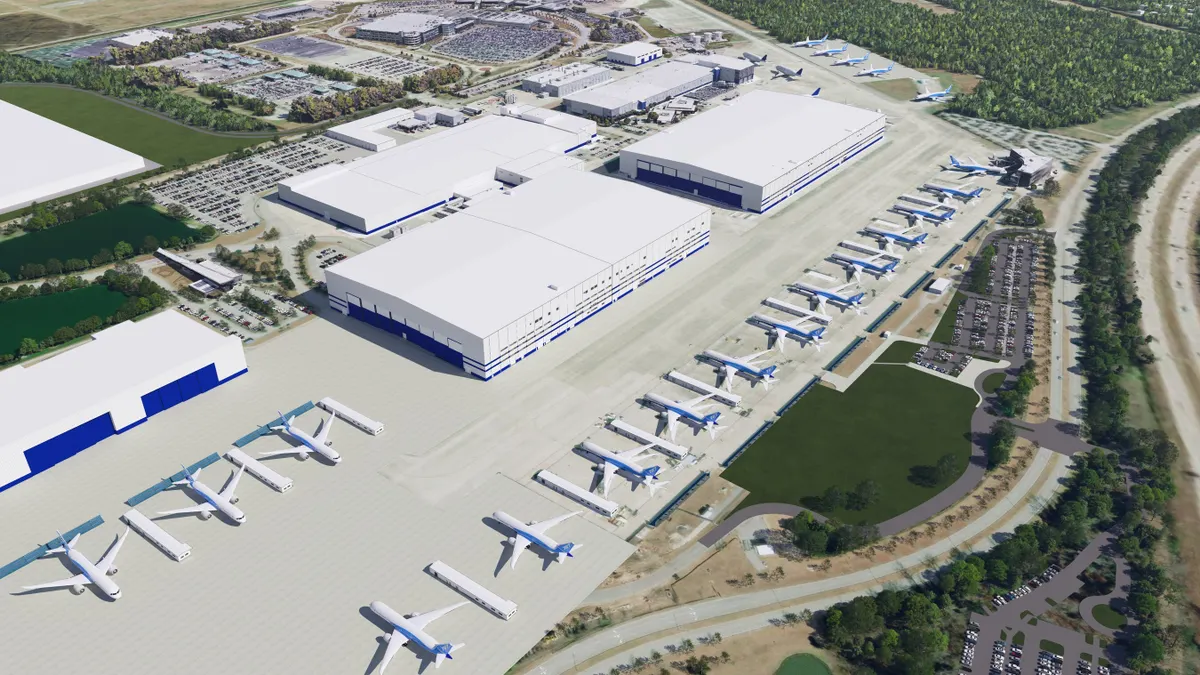
Boeing also broke ground on a $1 billion expansion and upgrade project for two 787 Dreamliner campuses in North Charleston, South Carolina, in November 2025. The company aims to up its monthly 787 production rate from eight to 10 later this year, said Ortberg.
Though the most critical impacts for Boeing are related to the delayed certification and first delivery of its 777x aircraft, as well as prior delivery delays on the 737 and 787 programs, Malave added.
The first delivery of the 777x is planned for 2027, but Boeing’s production system expenses will be higher than the predelivery payments the company expected.
“[Predelivery payments] for 777X are lower than they otherwise would be, given customers have been paying into a schedule that previously assumed first delivery in 2026,” Malave said. “2026 is planned to be a higher use than 2025 but we expect the net cash use to improve over the next few years before turning positive in 2029. Our focus here remains on progressing through flight testing with the FAA.”
Two issues associated with the 737 and 787 programs are driven by previous delivery delays — customer considerations and excess advances, the CFO added. Furthermore, Boeing aims to increase its monthly 737 production to 47 and later 52 planes, Ortberg said. In October 2025, the Federal Aviation Administration agreed to increase 737 production from 38 to 42 planes per month, as the agency increased oversight of Boeing’s manufacturing at its commercial plane factories in Washington following the 2024 Alaska Airlines door blowout.
“To be clear, customer considerations for prior delays are not diminishing the pricing levels we are applying to new business,” Malave said. “Indeed, we are seeking to better manage delay exposure in new contracts with tighter underwriting standards.”
The company anticipates the impacts to improve over the next few years.
“Our path to resolve the impacts of both customer considerations and excess advances is all about production stability and continuous improvement in on-time delivery for our [Boeing Commercial Airplanes] customers,” Malave said.
Boeing will also spend money on its agreement with the Department of Justice, which Malave said will occur this year. In November 2025, a federal judge dismissed criminal charges against Boeing in connection with two 737 Max aircraft crashes that killed 346 people. Boeing and the DOJ reached a $1.1 billion settlement agreement in May that will go toward paying a criminal penalty, the victims’ beneficiaries fund and improving the manufacturer’s compliance, safety and quality programs.