As manufacturers look to implement robotics to enhance their production and automation systems, a growing number of startups — including Agile Robots — are advancing technologies for industrial use.
Earlier this month, Agile Robots closed on a deal to acquire assets from Thyssenkrupp Automation Engineering, a move that allows the growing startup to tap into new sectors such as consumer electronics, medical technology and logistics. It plans to operate the division as Krause Automation moving forward.
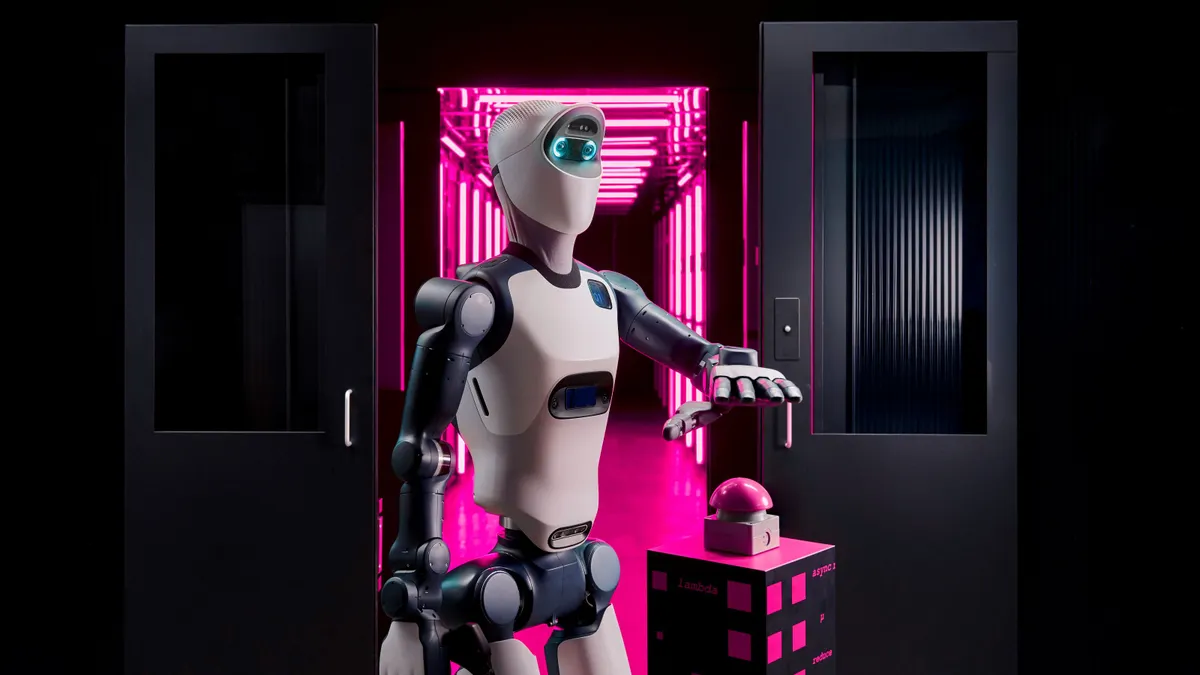
The Munich-based company also has recently partnered with Google DeepMind to develop robotics automation for industrial uses and began production this year of its first humanoid robot, known as Agile ONE.
Since its founding in 2018, Agile Robots has doubled its revenue year over year, reaching around 200 million euros ($235 million) in 2024, according to the company’s website. It employs more than 2,500 people globally, with production operations in China, India and Germany.

CEO Zhaopeng Chen founded Agile Robots after researching smart autonomous robots with colleagues at the German Aerospace Center, according to the company’s website. He had developed a humanoid hand, which became the basis for his first venture with Agile Robots co-founder Peter Meusel: Wessling Robotics. Chen has lived in Bavaria, Germany, for nearly two decades.
Chen spoke with Manufacturing Dive about the recent acquisition, Agile Robots’ physical AI strategy and what lies ahead for the growing Munich-based startup. He answered questions via email for this interview.
This interview has been edited for clarity and brevity.
MANUFACTURING DIVE: Agile Robots recently closed on a deal to acquire assets from systems manufacturer thyssenkrupp Automation Engineering in Europe and North America. How does this deal fit into Agile’s overall physical AI strategy?
ZHAOPENG CHEN: The acquisition unites Agile Robots’ AI-powered automation solutions with more than 75 years of engineering and implementation expertise of what will now be known as Krause Automation. The expanded portfolio reinforces our position as a leading global provider of automation solutions spanning multiple industries.
As part of Agile Robots, Krause Automation will tap into new sectors such as consumer electronics, medical technology and logistics. Customers benefit from enhanced end-to-end expertise, ranging from industrial robots to plant integration — full service from early planning stages to successful project implementation.
By giving Agile Robots an even stronger industrial footprint the acquisition also strengthens our ability to harness the future potential of physical AI for industry — building systems that do not merely execute pre-programmed instructions, but perceive their environment, learn from real industrial data, and adapt in real time.
What market or business factors led to Agile Robots moving forward with the acquisition?
With its deep technological expertise, long-standing customer relationships, and decades of proven experience in the international automotive industry, Krause Automation will strengthen Agile Robots’ position in next-generation smart automation solutions while expanding into new growth markets.
The acquisition brings us approximately 650 new employees and significantly improves our access to key global markets. By combining classical plant engineering with AI-based robotics, we are creating a strong, complementary foundation for next-generation industrial automation — enabling us to shorten innovation cycles and deliver even more flexible, efficient and scalable solutions to our customers.
How does the acquisition expand Agile Robots’ customer base?
The acquisition further strengthens Agile Robots’ engineering expertise and expands its global network with established locations and supply chain operations in all major industry markets. This gives us direct access to established customer bases in key industrial regions and positions us to serve a broader set of industries beyond automotive, including consumer electronics, medical technology and logistics.
What opportunities does this deal open up for Agile Robots?
By combining classical plant engineering with AI-based robotics, we are creating a powerful foundation for next-generation industrial automation. This enables us to shorten innovation cycles, expand into new market segments and deliver even more flexible, efficient, and scalable solutions to our customers — fully optimizing end-to-end production lines.
The automotive industry is undergoing profound structural change, and physical AI offers a concrete path forward. With the support of Agile Robots, Krause Automation will utilize new resources to deepen its expertise and expand its presence in this critical sector in North America and globally. More broadly, the deal accelerates our vision of physical AI: offering customers smart automation solutions, from robot hardware and AI software to full plant integration.
How much did Agile Robots pay for the assets?
We are not disclosing this information.
What industrial use cases are you prioritizing with the Google DeepMind collaboration?
With Google DeepMind contributing frontier AI models and leading research in embodied intelligence, and Agile Robots contributing industrial robotics platforms, advanced manipulation hardware and real-world deployment environments, the teams will continuously train, test and improve intelligent robots through real-world operation.
The partnership is about developing adaptable robots, so we aim to apply our combined technologies across any task or process. To show the capabilities of our collaboration, this will include tasks like complex assembly or cable routing.
What sectors specifically are you and Google DeepMind aiming to develop physical AI for?
The goal of the partnership is to advance physical AI where intelligent robots can reason, adapt and operate autonomously in complex real-world environments.
The focus will be on high-value industrial use cases in sectors with acute and growing demand for adaptable, reliable automation. This includes industrial and manufacturing tasks where reliability and scale are critical. By combining Google DeepMind’s frontier AI models with Agile Robots’ industrial robotics platforms, the collaboration aims to improve the capability, reliability and adaptability of robots deployed in industrial settings.
Agile Robots aims to bring cutting-edge AI into real-world robotic systems for industrial environments including manufacturing, automotive, supply chain and logistics.
Agile Robotics has installed more than 20,000 robotics solutions around the world. How are companies implementing your robotics currently? Where are they finding the most benefit?
Organizations realize the most optimal benefits when automation moves beyond fixed, repetitive tasks into a more dynamic environment. The industries where we see the strongest traction are those with highly standardized or recurring workflows — automotive, electronics, logistics, and mechanical engineering. The real value comes from matching the right automation with the right use case; it's taken us 20,000-plus deployments to achieve this.
What has interest been like from industrial customers around Agile Robotics’ humanoid?
Interest in Agile ONE has remained strong since November’s launch. We are talking with selected partners and early customers — not so much about Agile ONE as a standalone solution, but as a primary component within a wider intelligent production system.
How does Agile Robots plan to scale production of its robots over the next five years?
AI robotics, including physical AI, is projected to be a multihundred-billion dollar market within the next decade. Agile Robots will continue to be at the core of this growth and zero in on solving our customers' challenges with our technology.
With one of the largest R&D teams in the AI and robotics industry, comprising more than 1,500 R&D specialists and more than 3,200 employees worldwide, Agile Robots continues to push the needle in creating the most cutting-edge robotic solutions.