
US solar manufacturing momentum affected by shifting tax credits
The U.S. solar manufacturing and supply chain and the industry at large saw major gains in 2025, but they face an uncertain market heading into 2026.
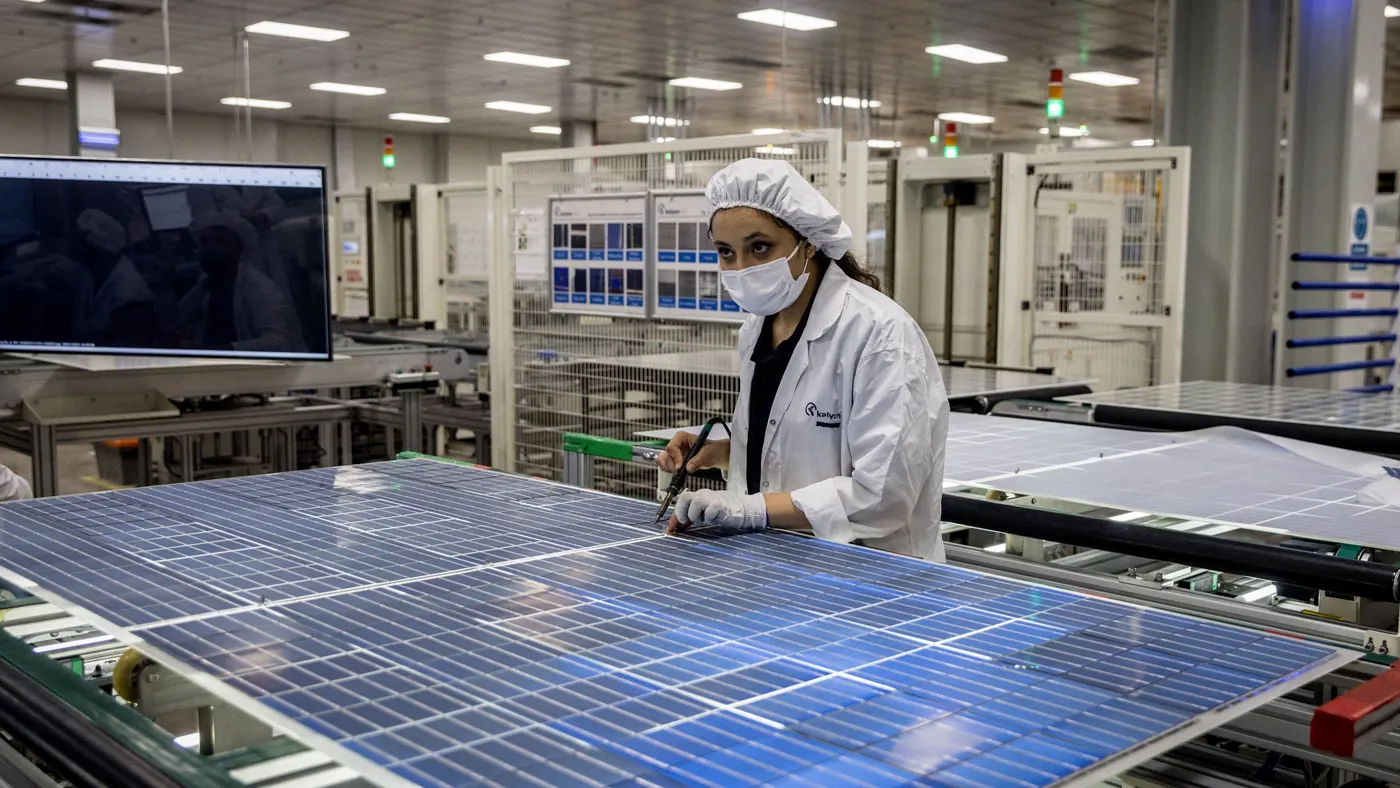
According to the Solar Energy Industries Association, the U.S. can now produce “every major component of the solar supply chain” with growth across multiple categories. This included a 300% increase in solar cells and a 37% increase in solar module production, bumping capacity beyond 60 gigawatts, between the end of 2024 and late 2025.
Despite those gains, some experts say the industry is still far from supplying what the domestic market requires. And the crosswinds of sunsetting tax credits, increased eligibility thresholds and tariffs create a difficult environment for business decisions.
“You’ve seen pretty distinct growth and investment, particularly on the module side. You’ve seen more of it on the cell manufacturing side in the last five years, thanks to tax credits. But we still have a long way to go as an industry in terms of reshoring the rest of that sector,” said Scott Moskowitz, vice president of market strategy and public affairs at manufacturer Qcells.
President Donald Trump’s One Big Beautiful Bill Act is among the top uncertainties that could slow momentum.
OBBBA accelerates the phase-out of the Investment Tax Credit for solar projects started after 2027 and increases content requirements for the Domestic Content Bonus. While the bill maintains the Section 45X Advanced Manufacturing Production Credit for solar manufacturers, it also sets new exclusions to businesses with connections to Foreign Entities of Concern.
On the other hand, Trump’s widely publicized tariffs introduce a level of market protection that may shield companies from international competition.
Experts say these conflicting political decisions are causing collateral damage to the solar industry.
“Unfortunately [OBBBA] got caught up in an ideological back and forth. People started to pick on technologies that they felt had been favored — the solar, the wind,” said Mike Carr, executive director of the Solar Energy Manufacturers for America Coalition.
The road to reshoring
Until recently, support for U.S. solar manufacturing has been largely bipartisan, supported by trade policy and tax credits. “We are on our fourth straight presidential administration of relatively, I wouldn't call it consistent, but generally support of using trade policy as a tool to support manufacturers,” said Moskowitz.
Trump’s first administration offered the first of such beneficial conditions via the Section 201 safeguard, imposed in 2018. This allowed the U.S. to enact temporary tariffs on a wide range of products when imports surged.
In response, Qcells made its first investment in the U.S. with the opening of a $200 million solar panel manufacturing facility in Dalton, Georgia. The facility was the largest of its kind in the Western Hemisphere at the time.
“It was really the kind of market protection that they felt like they had been lacking for a long time,” said Carr. “And it was enough to kind of begin to really think about what a reshoring effort could look like.”
Under President Joe Biden, the Inflation Reduction Act established the Section 45X tax credit and expanded and extended the ITC, offering 30% credit for solar projects through 2032.
Martin Pochtaruk, CEO of solar panel manufacturer Heliene, said the credits and resultant market growth directly helped his company secure a $150 million investment for its new Rogers, Minnesota manufacturing line in 2024.
However, the accelerated phase-out of the ITC and modification of 45X under OBBBA threatens the momentum of such crucial efforts to grow production capabilities.
“We took a pretty substantial hit to manufacturing when they prematurely phased out the ITC for solar, and importantly, from our perspective, the domestic content incentive that went with it,” said Carr. “It reintroduced uncertainty into a fairly certain equation.”
A three-legged stool approach
In the wake of the COVID-19 pandemic, manufacturers are more eager than ever to localize their production networks.
“We learned a lot as an economy during the pandemic, when supply chains were tested,” said Moskowitz. “We learned that no industry, and particularly a critical industry like energy, wants to be dependent on imported products if they don't have to be.”
Business leaders say reversing certain tax credits while advancing tariffs has created a precarious situation.
“Tariffs are not a particularly nimble approach. It takes time for them to be effective. There’s a lot of lobbying against them,” said Carr. “And they’re often time-limited, even in their implementation. Even the [Section] 201 tariffs that started in 2018 were due to expire by 2021, right? That's not the kind of time frame that allows for scale investments.”
Those provisions, which enabled Qcell’s $200 million investment, were ultimately extended for four years, but the shifting policy landscape remains challenging.
ording to Carr, reshoring U.S. solar manufacturing demands a three-legged stool approach: tariffs for market protection, supply-side policies to enable multibillion-dollar investments and a domestic content incentive.
Chopping off one leg — by accelerating the sunset of a domestic content incentive that stimulated demand for American-made parts — forces the industry to rely on shifting tariffs and supply-side policy.
Limits of the current domestic supply chain
Still, there’s no denying that domestic solar manufacturing is on the rise. Corning’s newest hub in Michigan, which aspires to “grab up to 15% of the U.S. market for wafers” — in addition to Nextpower’s Tennessee expansion — proves that both upstream and downstream production is in demand.
But while each individual part of the solar manufacturing sector exists in the U.S., there is not enough to meet all of the current domestic demand, said Moskowitz.
Pochtaruk echoed the idea, saying the U.S. may have successfully reshored the entire solar supply chain, but “it’s far from supplying what the market requires.”
“Corning’s amazing factory is [now] in place, but it’s just starting up,” said Pochtaruk. He added that the market will still require imports to supplement production.
Corning has not confirmed the plant’s size, though some analysts approximate a 2.5GW capacity.
Experts agree that policy stability would help with growth, especially when it comes to justifying major investments that might take up to 10 years to amortize, said Pochtaruk.
Referring to Corning’s Michigan factory, he said, “What was the investment? $900 million? You invest that for a long, long time. It’s not just one four-year cycle.” Corning ultimately increased its investment to $1.5 billion, further extending the amortization timeline.
“This market takes a long time to develop, and it takes a while to build a new factory and for the sales channels to develop,” said Carr. “The biggest thing that has been tough for this industry is the on-again, off-again nature of policy support around it.”
With demand for power skyrocketing and solar widely considered the cheapest form of energy, Carr said the question isn’t whether solar-powered electricity will be in demand or desired, but how much the U.S. will contribute to its production.
“It’s going to continue to be used in our economy. It is, to a certain extent, an inevitability. What's not inevitable is that we make it,” said Carr. “Do you want to allow reshoring? Or are you comfortable with these kinds of products being made by a sometimes hostile power, or at the very least a trade competitor? We’ve heard from policymakers on both sides of the aisle a resounding ‘no.’”