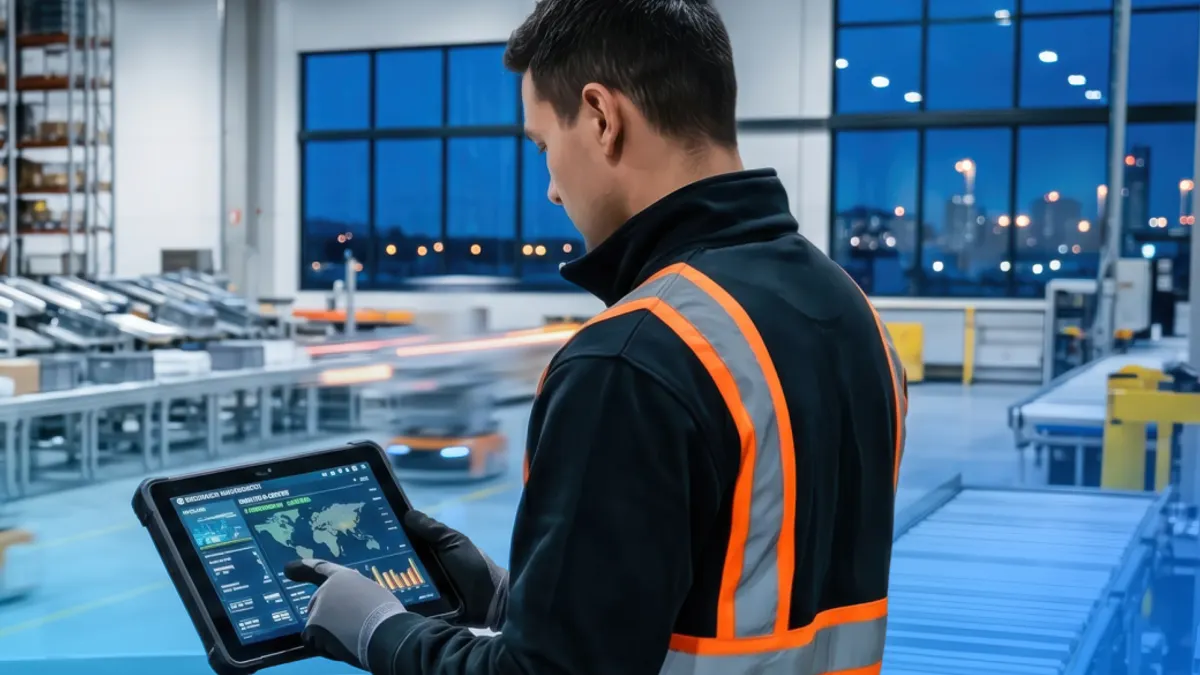

AI is transforming the factory floor faster than most security controls can adapt. Just as AI use cases like predictive maintenance, autonomous inspection and self-optimizing production lines are proliferating, attackers are exploiting the use of AI as well. All of these applications require infrastructure that’s secure by design. That means protection is built into the architecture itself, rather than added as a separate layer after deployment. A full-stack approach distributes security into every layer of the stack, from the data center to the plant floor.
A new type of threat
As we observe Cybersecurity Awareness Month, the industry is still processing the implications of frontier AI models. These models can now autonomously discover and exploit infrastructure vulnerabilities before defensive measures can stop them.
For manufacturers, this should be a wakeup call. As IT and operational technology (OT) systems converge to support AI-driven automation, the attack surface extends to the plant floor. A breach doesn’t just mean stolen data—it can halt production lines, introduce safety risks and cause costly, extended downtime.
Fragmented IT/OT security is now a liability
IT and OT have historically operated separately, each with its own security approach. Now that AI workloads require these systems to interact (e.g., pulling sensor data, running analytics and powering automation in real time), that separation has become a liability.
Adding new security tools to existing security solutions has resulted in a patchwork of disconnected systems, each watching a different corner of the plant floor with no unified view of risk. Every new sensor, controller or AI-enabled machine added to the network creates another blind spot. A single line stoppage can be extremely costly, so these potential security gaps threaten production continuity, worker safety and throughput targets.
Modernization is the business case for continuous defense
The old approach to security was: harden it, prove it, don’t touch it. Major upgrades were made every 12 to 24 months, aging gear was kept in service and risk exceptions were documented and tolerated. That worked when adversaries needed months to implement attacks. It doesn’t work that way now. Security must be real time and multifaceted.
The new approach to security is: harden it, prove it and continuously defend it at machine speed. That starts with hardening your infrastructure by evaluating aging assets continuously rather than only during specific refresh cycles and viewing modernization as the ongoing removal of what can’t be made safe. According to recent research by Omdia, commissioned by Cisco, 94% of organizations have regrets about their initial AI infrastructure strategy, saying, among other things, that they should have invested in their own infrastructure sooner.
A resilient foundation starts with an integrated stack
Most industrial networks were built for legacy programmable logic controllers (PLCs) and traditional compute. They were not designed for the massive east-west traffic and GPU-intensive workloads. Forcing outdated infrastructure to handle these demands often creates slowdowns and failures in exactly the areas where speed and reliability matter most.
Manufacturers build a resilient foundation by running full-stack infrastructure as one system, from the data center to the factory floor. Security isn’t a layer on top; it’s distributed into every layer of your stack, from core to edge. That means you can stop lateral movement, shield infrastructure from vulnerabilities before a patch window opens and close policy gaps that attackers can exploit.
The shift manufacturers need to make is to look at modernization as the foundation that allows AI-driven automation to scale safely, not as a cost of doing business.
Moving forward without starting over
Modernizing IT/OT infrastructure doesn’t require starting from scratch. It does require an intentional strategy that accounts for the realities of running a manufacturing environment under constant production pressure.
That’s why Cisco developed The Data Center Lens, a monthly video series offering field-level guidance for modernizing infrastructure at scale, addressing the practical realities IT leaders face when integrating AI into existing IT/OT environments.
For manufacturers ready to take the next step in their modernization journey, Cisco data center solutions offer a starting point for building the resilient, unified IT/OT infrastructure today’s AI-driven factory demands.