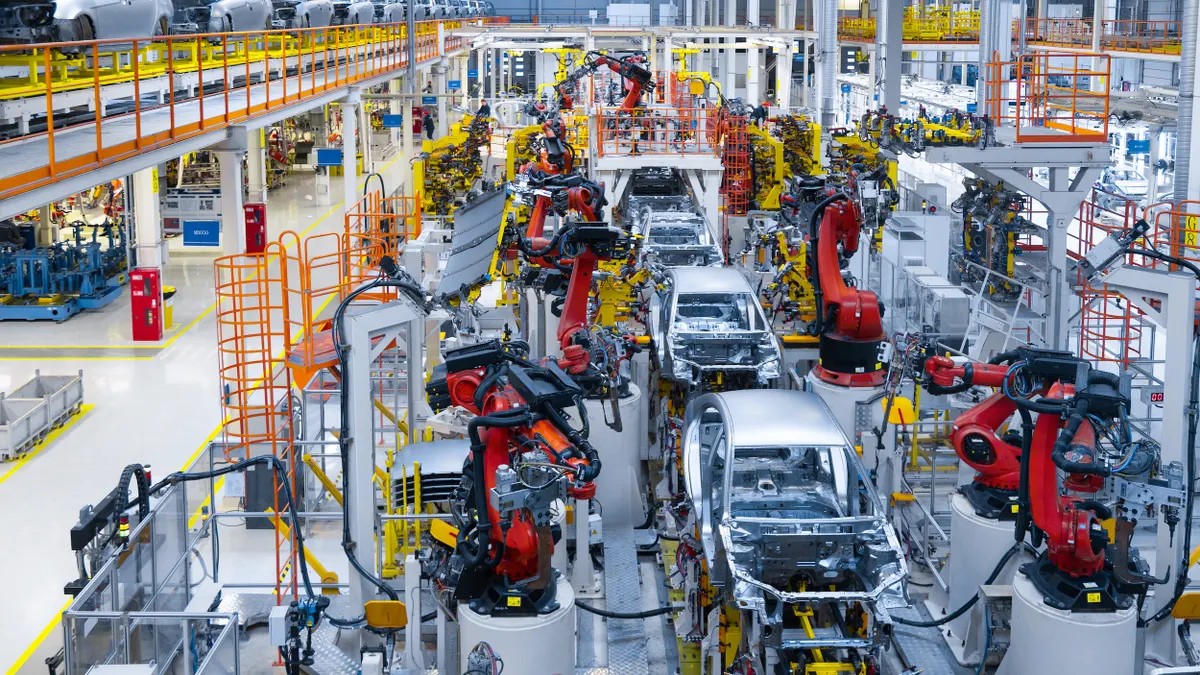

Artificial intelligence is no longer a future concept for manufacturers. It is already reshaping how factories operate, how supply chains respond and how leaders make decisions. Predictive maintenance reduces unplanned downtime. Intelligent planning systems balance inventory and demand. Computer vision improves quality inspection at scale.
As AI becomes embedded in industrial operations, it is starting to resemble other foundational technologies that once transformed manufacturing, such as electricity or the internet. Yet despite this momentum, most organizations remain unprepared to adopt AI in a way that delivers sustained value. According to Cisco’s 2024 AI Readiness Index, only 13% of companies are fully prepared to make the shift.
For manufacturers, that readiness gap can be costly. AI initiatives often struggle not because the technology is immature, but because organizations are not structurally prepared to support it. Readiness, not tools, is increasingly the determining factor between isolated pilots and meaningful operational impact.
Readiness starts before the technology
Across manufacturing, executive teams are paying closer attention to AI. Strategy decks reference automation and machine learning, and budgets are set aside for experimentation. Yet many initiatives never reach daily workflows.
Research reflects this disconnect. While McKinsey reports that 78% of organizations use AI in at least one business function, Stanford HAI found that only 12% of enterprise leaders believe their data is ready for scaled AI.
What’s missing is alignment. AI readiness depends on three interdependent layers:
- Executive alignment
- Cultural openness
- Operational and data infrastructure
When one layer is weak, the entire effort becomes fragile. Leadership without infrastructure creates frustration. Technology without cultural trust slows adoption. Data without governance undermines confidence in outcomes.
Executive alignment: From curiosity to clarity
In manufacturing environments, AI success begins with focus. Leaders must connect AI initiatives to real operational challenges—planning inefficiencies, volatile demand, production bottlenecks or rising costs.
Organizations that struggle with AI often begin with technology selection rather than problem definition. Those that succeed reverse the sequence. They identify where decisions are slow or unreliable and explore how AI might help address those specific issues.
This clarity enables better prioritization. Instead of chasing disconnected pilots, leadership aligns teams around a small number of business-critical outcomes. AI becomes a means to improve reliability, efficiency or planning—not an abstract innovation effort.
Culture: Making AI work for people
Even with executive alignment, AI adoption depends on how it is experienced by the workforce.
Manufacturing teams are encountering AI more frequently, but guidance has not always kept pace. A Gallup poll found that while AI usage among U.S. employees nearly doubled from 2023 to 2025, only 22% say their organization has communicated a clear strategy for how AI fits into their roles.
This gap can create anxiety, particularly for frontline teams and middle managers balancing safety, quality and output. When AI tools appear without context or involvement, they can feel imposed rather than supportive.
Organizations that build readiness emphasize participation. Involving people closest to the work helps ensure AI tools reflect real workflows. When employees understand the purpose of AI and see how it reduces friction, adoption improves and resistance decreases.
Infrastructure: The backbone manufacturers can’t ignore
Even with clear strategy and a supportive culture, AI will not scale without the right foundation.
That foundation includes integrated systems, consistent data, scalable platforms, and governance designed for long-term use. According to McKinsey, only 21% of companies report that their systems can support AI at scale.
Manufacturers often struggle with fragmented data spread across ERP systems, production platforms, spreadsheets and legacy tools. AI models trained on incomplete or inconsistent data produce unreliable results, eroding trust and slowing adoption.
Improving readiness often means revisiting fundamentals: mapping data sources, improving quality, integrating systems and building platforms that can evolve over time. AI does not require perfect data, but it does require consistency.
When readiness delivers results
Manufacturers that invest in readiness move AI beyond experimentation. Predictive maintenance reduces downtime. AI-driven planning shortens cycles and reduces waste. Intelligent automation improves quality, documentation and response times.
These outcomes are most sustainable when AI is embedded within aligned systems, supported by leadership and trusted by the workforce.
AI readiness is not a one-time milestone. It is an ongoing discipline that helps manufacturers adapt as tools, data and business needs evolve. The real shift is not about adopting more technology—it is about building the conditions that allow AI to improve how work gets done every day.