
Manufacturers today are under constant pressure to deliver better products in less time. From labor shortages and supply chain challenges to rising customer expectations and growing product complexity, organizations are looking for new ways to accelerate innovation while maintaining quality and controlling costs.
As a result, technologies such as artificial intelligence, digital twins, real-time simulation and immersive visualization are becoming integral to modern manufacturing strategies. These technologies are helping teams make faster decisions, reduce development costs and bring products to market more efficiently.
However, the success of these initiatives depends not only on software and processes, but also on having the right computing infrastructure to support increasingly demanding workloads.
Digital engineering is reshaping product development
Manufacturers have long relied on physical prototypes and iterative testing to validate designs. While these methods remain important, organizations are increasingly shifting portions of the development process into digital environments.
Digital twins and virtual prototyping allow engineers to design, test and optimize products before a physical model is ever built. Teams can simulate real-world operating conditions, identify potential issues early and evaluate multiple design alternatives without the cost and delays associated with traditional prototyping.
By enabling faster iteration and more informed decision-making, digital engineering helps organizations accelerate product development while reducing risk.
AI is driving faster innovation
AI is transforming how manufacturers approach design, engineering and product development.
Today's engineering teams use AI agents to automate repetitive processes, analyze large datasets, generate design recommendations and improve productivity across complex workflows. AI and AI agents help engineers spend more time focusing on innovation and less time managing manual tasks.
As AI adoption continues to grow, manufacturers are discovering new opportunities to improve efficiency, optimize product performance and make faster, data-driven decisions throughout the product lifecycle.
Real-time simulation creates new competitive advantages
Simulation has become one of the most valuable tools available to modern manufacturers.
Whether evaluating structural performance, airflow, robotics systems, factory layouts or production processes, simulation enables teams to test scenarios virtually before making costly real-world changes.
Combined with advanced visualization technologies, simulation creates opportunities for engineers, designers and decision-makers to collaborate more effectively. Teams can review designs in greater detail, identify issues earlier and gain deeper insights into product performance before production begins.
These capabilities help reduce development cycles, improve product quality and support faster innovation.
Why workstation performance matters more than ever
While AI, simulation and visualization technologies create significant opportunities, they also place greater demands on engineering infrastructure.
Large CAD assemblies, complex simulations, high-resolution visualization and AI-enabled applications require powerful hardware capable of processing vast amounts of data efficiently. When workstations struggle to keep pace, productivity slows as users spend valuable time waiting for models to load, simulations to complete or renders to finish.
To support these next-generation workflows, manufacturers are increasingly investing in workstation technologies designed specifically for professional AI, graphics and compute applications.
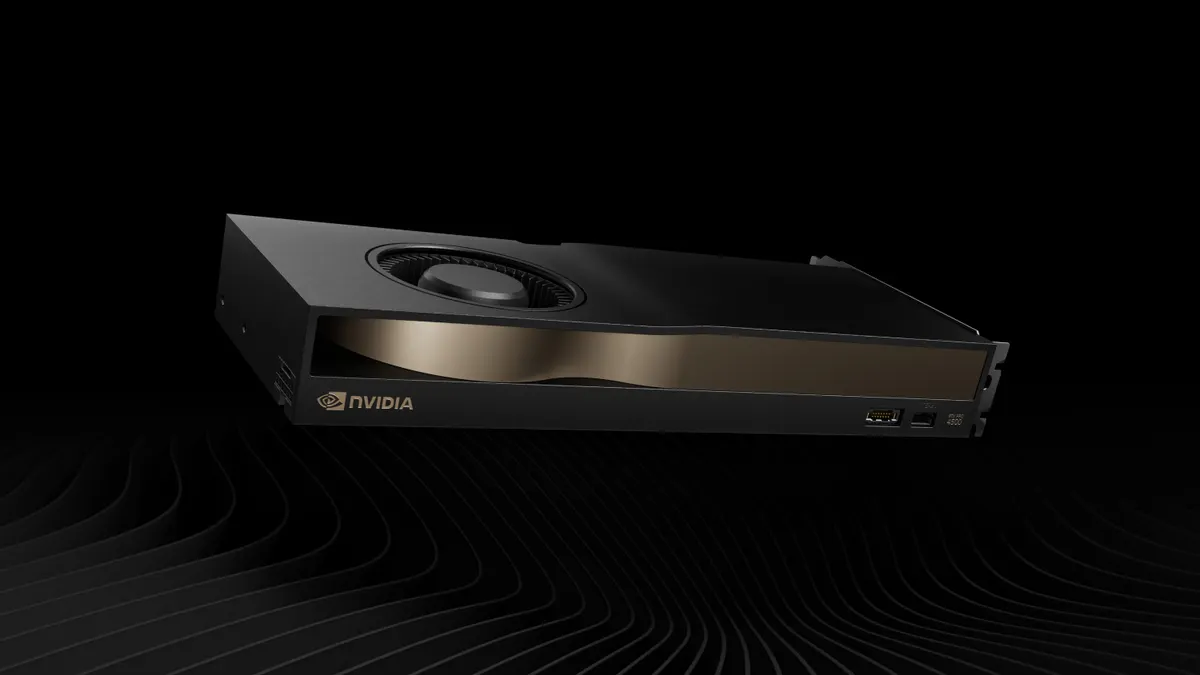
Available through PNY, the NVIDIA RTX PRO 4500 Blackwell Workstation Edition is designed to help manufacturing professionals tackle demanding engineering, simulation, rendering and AI workloads. Built on the NVIDIA Blackwell architecture, it combines advanced AI acceleration, neural rendering capabilities and 32GB of high-speed GDDR7 memory to support data-intensive professional applications.
The RTX PRO 4500 features fifth-generation Tensor Core technology, fourth-generation NVIDIA RT Cores and advanced NVIDIA CUDA Cores, enabling professionals to accelerate AI-driven workflows, create highly detailed visualizations and work with increasingly complex engineering models. For manufacturers adopting digital engineering strategies, these capabilities can help support greater efficiency, faster design iteration and improved collaboration across teams.
As an NVIDIA Elite Partner, PNY helps organizations deploy NVIDIA RTX professional GPUs that support modern engineering and manufacturing workflows, providing access to technologies designed for AI, simulation, visualization and product development initiatives.
The future of manufacturing is digital
The manufacturing industry is undergoing a fundamental shift toward digital-first development. AI, digital twins, simulation and visualization are no longer emerging technologies; they are becoming core tools for improving efficiency, increasing agility and accelerating innovation.
Organizations that combine modern engineering workflows with high-performance computing infrastructure will be better positioned to develop products faster, reduce costs and remain competitive in an increasingly complex market.
Ready to advance your manufacturing workflows? Discover the NVIDIA RTX PRO 4500 Blackwell Workstation Edition at PNY.