
AI used to feel like something you’d come back to later, once you had more people and more time. For a growing product business, it was easy to file it under “interesting,” then return to the work that decides whether orders ship on time.
In 2026, that distance is shrinking. A useful pulse check comes from Rootstock’s 2026 State of Manufacturing Technology Survey. Predictive AI adoption was reported at 48%, up 12 points year over year. The same release notes AI investment moving toward supply chain planning, reaching 35%. It’s a signal that AI is being pushed toward day-to-day operations.
The data is one thing. The more interesting part is where it’s showing up in real companies. Some product businesses are already using AI to take pressure off small ops teams and keep the work moving when volume grows.
Business Insider recently described how Spot & Tango, a fresh dog food delivery business, started using an agentic AI tool in its operations.
When the company opened its facility in late 2022, procurement and scheduling depended on manual coordination. The team piloted an agentic AI tool that logs and confirms purchase orders, then builds production schedules based on ingredient availability. The logistics team reviews the decisions. After three months, they expanded its use.
Without a custom AI build or a long IT project, Spot & Tango says about 60% of purchase orders are now fully automated. Their small ops team tested the product in a short window, rolled it out and used the time savings to scale output without hiring at the same pace.
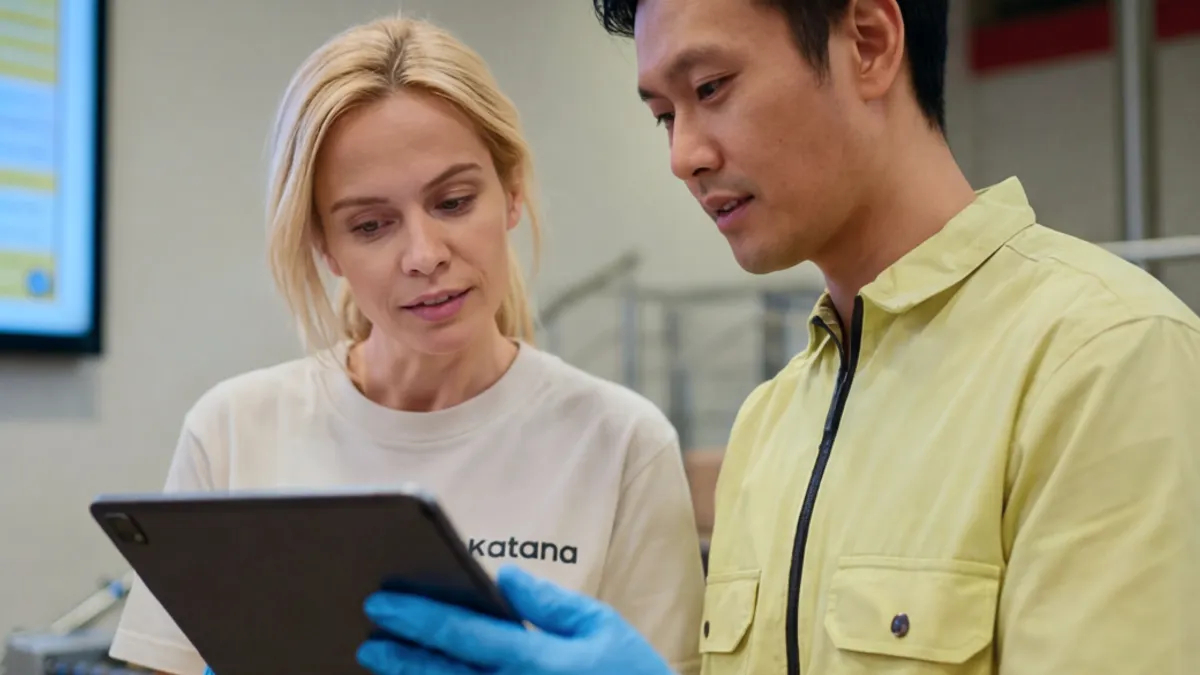
And time savings are only part of what AI is starting to change for small and medium product businesses. SMB-dedicated tools, like Katana Inventory Software, are actively investing in making AI part of the workflow itself.
That means, for example, AI-driven demand forecasting and supply planning.
Businesses using Katana can use AI to pull from live inventory and order data to spot signals that used to surface in weekly reviews, after the window to respond had closed. Things like a product trending faster than forecast, a supplier delay that will tighten stock in two weeks or slow-moving items eating working capital.
Built into the daily workflow, AI can flag risks while there's still time to adjust purchasing or shift production schedules. It reads operational data teams already track, and surfaces what needs attention, when it needs attention. Demand forecasting happens continuously instead of monthly. You spot red flags like stockout risks and supplier delays earlier and make decisions before those issues compound.
For product businesses that managed stock in spreadsheets until recently – or still do and are considering a step-up – that opens the door to scaling output and complexity without taking on a matching cost or operational strain.
Five years ago, this level of planning capability required enterprise budgets and dedicated data teams. The AI that used to separate enterprise manufacturers from everyone else is now available in tools SMBs already rely on, or that are easily integrated with their tech stack. AI has democratized tech for product businesses: the space between what a growing brand can do and what only large players can afford is narrowing.