With Congress’ passage of the 2026 National Defense Authorization Act last week, billions of dollars in funding have been approved to support U.S. manufacturing of weapons, vehicles and equipment that support the defense industry.
The 3,086-page defense bill, signed by President Donald Trump on Thursday afternoon, authorizes a host of policies valued at $901 billion, including a 3.8% pay raise for all military service members and funding to build or make upgrades to barracks, family housing and facilities.
There are also provisions that aim to bolster domestic manufacturing, upskill workers and adopt artificial intelligence, robotics and other advanced technologies across the U.S. defense industrial base. This network comprises commercial factories, research centers, university laboratories and government-owned operations.
Unlike appropriations bills, the NDAA does not provide budget authority for government activities. It is, however, a fairly reliable indicator of lawmakers’ sentiment regarding certain issues and programs.
Here are some key areas where the law is advancing U.S. manufacturing.
Expands the Defense Industrial Base Fund
Under Section 867, the U.S. Department of Defense now has more flexibility in how its Defense Industrial Base Fund can be used to address supply chain issues, expand production and advance domestic manufacturing.
The law’s modifications allow the agency to use fund dollars for materials, production, facility construction, testing and equipment needed for defense-related goods and services. The DIB funds can now go toward workforce investments, advanced manufacturing, machine tools, unmanned vehicles, sensors, batteries, critical minerals and other applications.
In July, Trump’s One Big Beautiful Bill appropriated $8.3 billion to the DIB fund for investments in critical minerals supply chains, as well as for general grants and purchase commitments through Sept. 30, 2029. Recipients cannot use the funding in adversarial countries, such as China and Russia.
Under Section 8001, the law also extends the Defense Production Act through September 2026.
The DPA, last authorized in 2018, gives presidents the authority to expand and speed domestic industrial base production via loans, grants and purchase guarantees. Previous administrations have invoked these powers for a range of reasons, including to increase supplies of medical equipment and shore up infant formula shortages.
Supports shipbuilding, munitions production and emerging technologies
The law authorizes $26 billion for U.S. Navy shipbuilding and infrastructure construction next year, providing greater spending flexibility for advanced ships.
The law provides full funding for a CVN-82 nuclear-powered aircraft carrier, the Ford-class aircraft carrier program, a Columbia-class ballistic missile submarine and a Virginia-class submarine, according to Virginia Rep. Bobby Scott. The funding also supports destroyers, connectors and smaller ships.
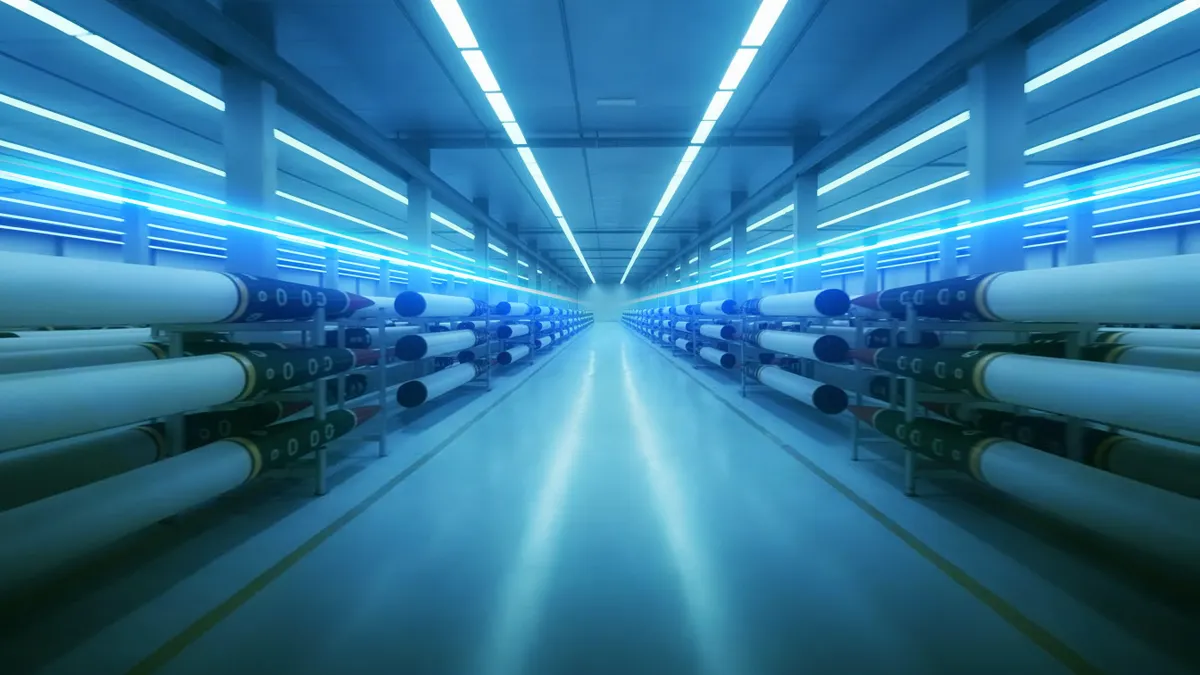
Additionally, lawmakers directed more than $25 billion to rebuild U.S. munitions stockpiles, including for precision strike missiles, torpedoes, anti-radiation missiles and artillery rounds, according to Virginia Rep. Jen Kiggans.
The law also authorizes more than $145.7 billion for research, development, testing and evaluation of emerging technologies, including hypersonics, artificial intelligence, quantum computing and autonomous systems, Kiggans added.
As part of this, the law directs the Army to create and run a program that advances munitions production by using robots and automation systems under Section 225.
Some of the program’s objectives are to design, integrate and safely scale load-assemble-pack systems, to demonstrate increased throughput while reducing human exposure to dangerous explosive materials and to build secure data systems that are resilient to cyber risks.
Creates the Civil Reserve Manufacturing Network
Under Section 1841, the law directs the Secretary of Defense to establish the Civil Reserve Manufacturing Network, a government-industry partnership that relies on commercial factories to produce “defense-critical” equipment at scale when needed, particularly during national emergencies or wartime scenarios.
The idea is similar to other reserve models, such as the Civil Reserve Air Fleet, where commercial airlines agree to commit their planes, crews and facilities to the Department of Defense during a crisis. This summer, House lawmakers proposed the idea of dual-use factories that leverage artificial intelligence to rapidly scale weapons production during wartime.
In June, the House of Representatives proposed $131.7 million to establish the network. However, Congress omitted a specific value in the finalized law. It also directed a plan to establish the network in the next 90 days and certify the first participating factory by fiscal year 2026.
Funds research and development of bioindustrial manufacturing
The law establishes a Biotechnology Management Office within the Defense Department to execute its biomanufacturing strategy.
It also lays the groundwork to create a program to support the expansion of domestic capacity for bioindustrial manufacturing through awards to companies looking to build, upgrade or retool their facilities.
In March 2023, the Biden administration established a strategy to support the research and development of biological systems to produce materials, chemicals, fuels and other defense-related goods. The new law orders a new strategy to be developed with a focus on biomanufacturing expansion and incorporation across the agency.
The Plant Based Products Council praised the language of the bill, saying that it would not only boost manufacturing and innovation, but ensure bio-based products are used for a wide array of defense applications.
Supports PFAS production
The law contains notable language about per- and polyfluoroalkyl chemicals, commonly known as PFAS. The U.S. military has long been a major user of PFAS, through applications such as aqueous film-forming foam, and is now on the hook for managing cleanup of the material as it has been designated hazardous by the U.S. EPA.
While the 2020 NDAA called for this use to be phased out by October 2023, this year’s law extends that to October 2026, or possibly later if waivers are approved.
The law also directs the secretary of defense to conduct an annual analysis of the cost to complete remediation of PFAS at military property. Additionally, the law does not continue a temporary moratorium on PFAS incineration was established in the 2022 NDAA.
It now says the agency may use technologies to destroy or dispose of PFAS as long as they are “cost effective” and “permitted or otherwise approved by a federal or state agency that regulates the destruction or disposal of such a substance.”
The DOD continues to support pilots and research for such technologies which can have implications for manufacturers, waste facility operators and others who are also faced with a need to manage PFAS.
Cole Rosengren contributed to this story.