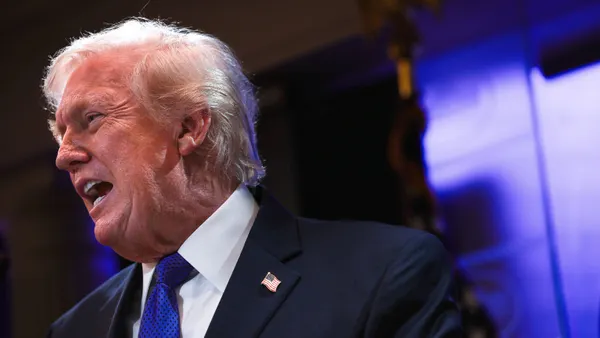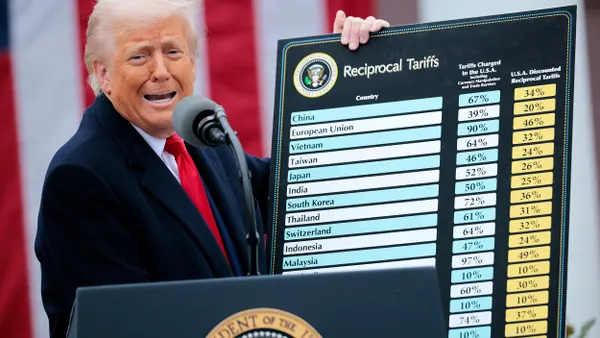

President Donald Trump said on Friday he will impose a 10% "across the board" tariff, insisting he has the authority to do so despite a Supreme Court ruling that struck down earlier global levies he imposed under a 1977 emergency powers law.
Trump told reporters at a White House news conference the tariff would be imposed under Section 122 of the Trade Act of 1974 and remain in effect for five months, during which the administration would conduct various investigations necessary to put "fair tariffs or tariffs period on other countries."
"So we're doing that period, but we're immediately instituting the 10% provision, which we're allowed to do," Trump said. "And in the end, I think we'll take in more money than we've taken in before."
Trump cited Supreme Court Justice Brett Kavanaugh's dissent in the 6-3 decision handed down Friday. Kavanaugh argued that Congress deliberately wrote the International Emergency Economic Powers Act in sweeping, flexible terms to give the president the authority to impose tariffs as a tool of economic pressure.
"IEEPA gives the President economic tools to address significant foreign threats," Kavanaugh wrote.
Kavanaugh stressed that even if IEEPA did not authorize Trump's tariffs, the president still had other statutory tools to install levies, including Section 232 of the Trade Expansion Act of 1962 and Section 201 of the Trade Act of 1974. Section 232 allows presidents to raise duties to address national security threats and Section 201 allows them to respond to unfair trade practices by other countries.
"In essence, the Court today concludes that the President checked the wrong statutory box by relying on IEEPA rather than another statute to impose these tariffs," Kavanaugh said in his dissent.
During the news conference, Trump listed the tariff authorities named by Kavanaugh, as well as others, acknowledging they require "a little bit longer process" than what he tried under IEEPA.
Before Friday's ruling, the Trump administration had already used Section 232 to implement a slew of sector-specific duties on goods such as steel, automobiles and furniture. The administration has also codified duties using other statutes, albeit with less broad reach than its use of IEEPA.