Manufacturing construction spending in the U.S. has gone down after peaking in 2024, according to the U.S. Census Bureau.
The latest report from E2 shows that in 2025, companies canceled over $32 billion worth of clean energy manufacturing projects due to reduced government incentives and funding cuts, as well as tariff policies.
But, at the same time, some industry giants have significantly increased investment in the U.S. Last year, Taiwan Semiconductor Manufacturing Co. announced a $100 billion investment with three new fabs, two advanced packaging facilities and an R&D center. Midyear, Micron revealed plans for a $200 billion investment in Idaho, New York, and Virginia with semiconductor manufacturing plants and an R&D center.
These investments partly stem from the new federal policies that aim to incentivize domestic production by making imports and hiring foreign workers more expensive. Other factors include funding from the CHIPS Act as well as state or local tax credits for job creation.
The announcements are a combination of building new facilities and expanding existing plants. Here are some of the biggest projects set to break ground or begin operations in 2026.
Micron
Product: Memory chips
Overall investment: $200 billion
Locations: Idaho, New York and Virginia
Timeline: Construction of the New York fab began in January
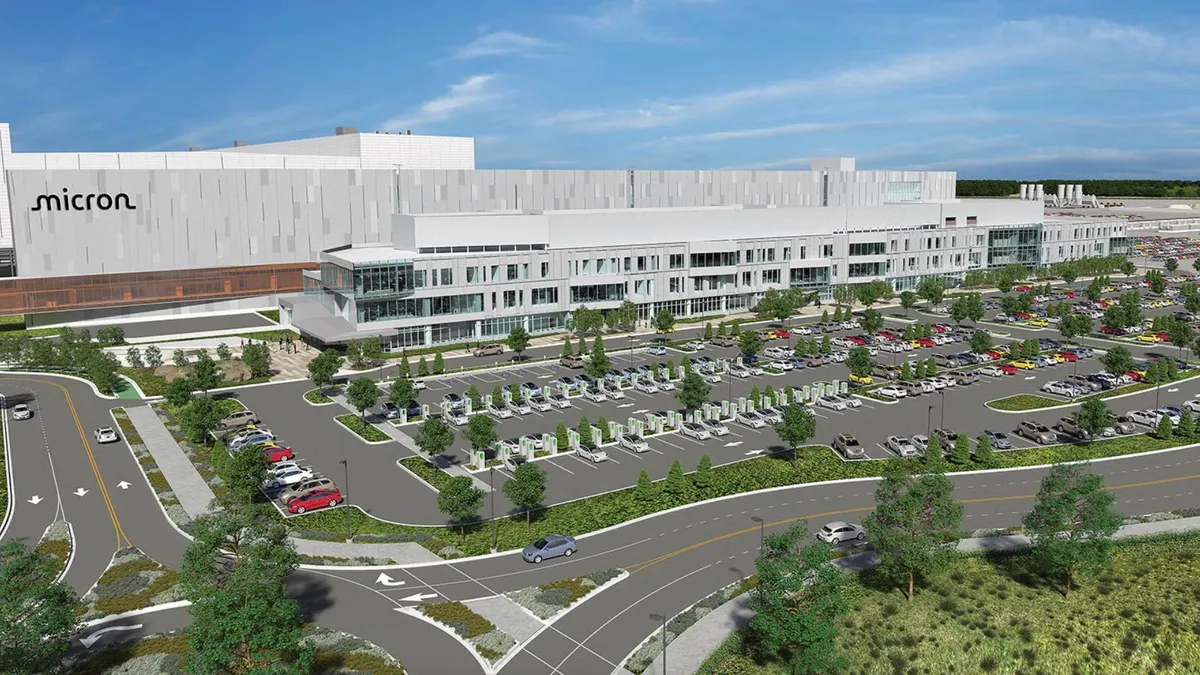
Micron’s memory manufacturing facility in New York broke ground earlier this month, and production at its Idaho site is expected to begin next year.
The company is investing $200 billion across multiple facilities, with plans to spend $150 billion on fabs and $50 billion on R&D. The project includes two fabs in Idaho, four fabs in New York and the expansion of its existing manufacturing fab in Virginia.
The project, which aims to produce 40% of the company’s dynamic random access memory in the U.S., is estimated to create 90,000 direct and indirect jobs.
The announcement was made in partnership with the U.S. Department of Commerce with $6.4 billion in funding through the CHIPS and Science Act.
Samsung Electronics
Product: Semiconductors
Investment: $17 billion
Location: Texas
Timeline: Expected to be operational in 2026
Samsung’s “initial minimum investment” for a semiconductor manufacturing plant in Taylor, Texas, is said to be the largest foreign investment in the state.
Construction was halted last year due to reduced demand and resumed in mid-2025. The factory is expected to be operational in 2026, and the company estimates the project will create 1,800 jobs within a decade.
Earlier, Samsung had planned $44 billion worth of investment in Texas, for which it was granted $6.4 billion in funding under the CHIPS Act. As the company reduced the investment to $37 billion, funding was cut to $4.7 billion.
The project is a part of a broader multibillion-dollar expansion in the region, where the company said it has invested over $47 billion since the 1970s.
Stellantis
Product: Vehicles
Investment: $13 billion
Locations: Illinois, Indiana, Michigan and Ohio
Timeline: Indiana facility begins production in 2026, others by the end of the decade
Stellantis is investing $13 billion across the U.S. to expand production by 50% over the next four years.
In Indiana, the company will produce a new four-cylinder engine beginning in 2026. In Illinois, there are plans to reopen a facility and begin production of two new Jeep vehicles in 2027.
In Michigan, the project will retool the Warren Truck Assembly Plant for a new range-extended electric vehicle and large SUV expected to be ready by 2028. The Detroit Assembly Complex will see production of the next-gen Dodge Durango by 2029.
This is the company’s biggest investment in the U.S. and is expected to create over 5,000 jobs.
Lilly
Product: Drugs
Investment: $27 billion
Locations: Alabama, Texas and Virginia
Timeline: Alabama facility breaks ground in 2026
Lilly is set to begin construction on its $6 billion active pharmaceutical ingredient manufacturing facility in Huntsville, Alabama, this year. The plant is part of the company’s $27 billion investment to build four new pharmaceutical production facilities across the U.S.
One of the confirmed sites includes a $6.5 billion plant in Houston. This facility is expected to be operational within roughly five years after construction begins. The second site is a $5 billion cancer drug facility in Richmond, Virginia, also expected to be completed in five years.
Together, the projects fall under the company’s broader plan to invest $50 billion in expanding production in the country, which it describes as the largest pharmaceutical investment in U.S. history.
Texas Instruments
Product: Semiconductors
Investment: $11 billion
Location: Utah
Timeline: Construction previously projected to begin in 2026
Texas Instruments is investing $11 billion to expand its semiconductor manufacturing with a new 300-millimeter fab in Lehi, Utah.
The new facility will be located next to the company’s existing fab, which it acquired from Micron in 2021.
Production is targeted to begin in 2026. It is expected to create about 800 direct jobs and thousands of indirect jobs in the coming years.
Rivian
Product: Electric vehicles
Investment: $5 billion
Location: Georgia
Timeline: Construction begins in 2026
Despite the Trump administration rolling back certain incentives, EV maker Rivian has started working on a long-delayed $5 billion facility in Stanton Springs, Georgia.
Construction is expected to ramp up in 2026, and the 9-million-square-foot site is scheduled to produce 400,000 vehicles annually by 2028.
The company is slated to receive $1.5 billion of incentives through the state if it creates 7,500 jobs paying at least $56,000 a year on average.