Dive Brief:
- Deere is targeting a 10% annual sales growth rate over the next five years as the company looks to be more technology-focused, SVP and CFO Josh Jepsen said at the company’s investor day event Monday.
- That translates to roughly $63 billion by fiscal year 2030 driven by a mix of technological advances, organic growth, market cycle improvements and inflationary pricing, Jepsen said. Deere’s net sales totaled $38.9 billion during fiscal year 2025.
- Meanwhile, President Donald Trump said at a farmers’ roundtable that equipment prices from Deere and other companies have “gotten too expensive,” in part because of “environmental excesses” that make the products complicated.
Dive Insight:
In recent years, Deere has made its Smart Industrial strategy, focused on intelligent, connected machines and applications, a key pillar of its operating model. Since launching the initiative in 2020, Jepsen said on the call that Deere has generated more than $30 billion in shareholder value.
“We’ve created a robust infrastructure that connects us to our customers, giving us the opportunity to accelerate the benefits of automation and autonomy across production systems,” Deere President and CEO John May said. “Importantly, we’ve also laid the groundwork for a new business model that can help our customers adopt and benefit from technology more quickly.”
To date, May said Deere has connected more than 1 million machines as part of its Smart Industrial strategy, and its cloud-based operations center covers 500 million engaged acres. The company is also leveraging automation across its manufacturing operations and for its products, such as sprayers and precision planters that aim to improve customers’ cost efficiencies.
“We aspire to reduce our customer greenhouse gas emissions through advanced equipment and technology,” Jepsen said.
During a Monday roundtable where Trump unveiled a $12 billion aid package for farmers, he also vowed to “take off a lot of the environmental restrictions” on heavy machinery imposed by the U.S. EPA in an effort to reduce prices.
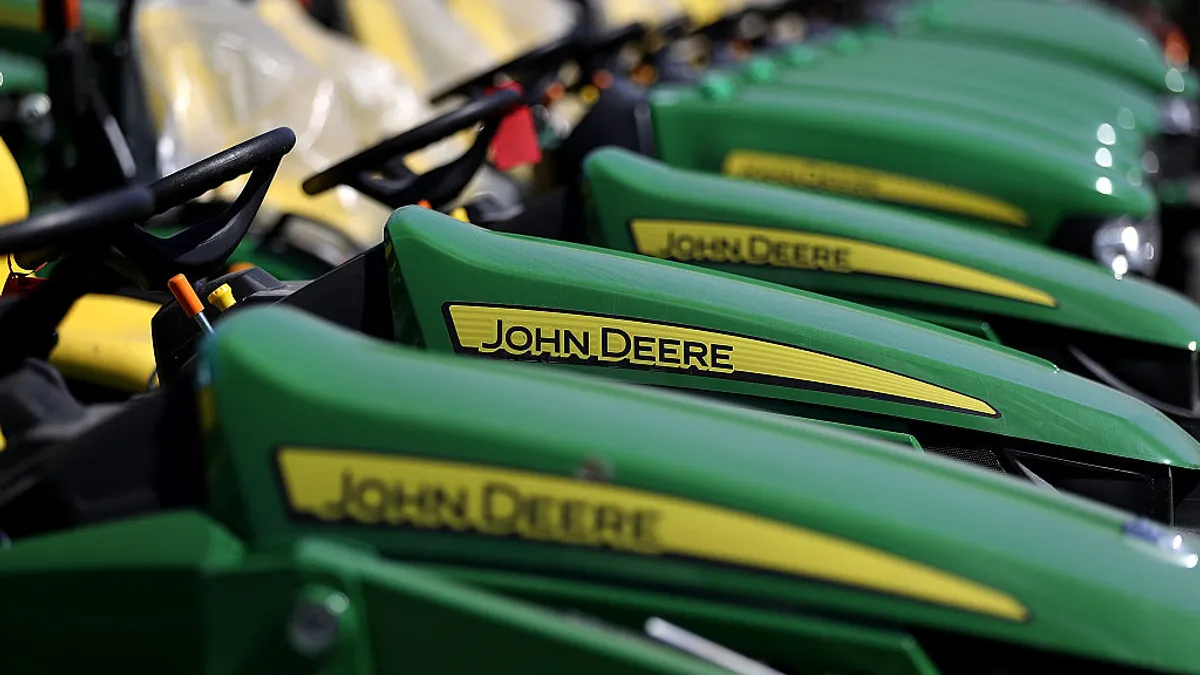
The “environmental excesses on the equipment...don’t do a damn thing except make it complicated, make it impractical,” Trump said. “In many cases, you need about 185 IQ to turn on a lawnmower now.”
Currently, Deere and other tractor makers must adhere to certain emissions regulations. Most recently, the EPA adopted standards that reduce emissions from “nonroad diesel engines” by integrating engine and fuel controls, according to its website. To meet the agency’s Tier 4 standards, implemented in 2004, tractor makers are required to produce new engines with advanced emission control technologies that use ultra-low sulfur diesel.
Following Trump’s comments, Deere posted on X that it supported the administration’s announcement of relief and bridge payments to farmers as they navigate difficult market conditions and is “ready to continue to work” with lawmakers to advance policies that support the rural economy.
“We are doing all we can to help U.S. farmers reduce input costs,” the company wrote. “The equipment and technologies Deere makes here in the U.S. are giving American farmers new tools and technologies that can substantially reduce their input costs and labor costs while increasing yields, boosting their margins.”