Dive Brief:
- Deere & Co.’s second quarter sales and revenue grew 5% to $13.37 billion over last year, driven by stronger than expected construction and forestry equipment demand as large agriculture sales remain muted.
- The John Deere tractor and bulldozer manufacturer reported net income of $1.77 billion during the quarter, a 2% decline from a year ago. The company also recognized a tariff refund of $272 million, which offset production costs and lifted margins during the quarter.
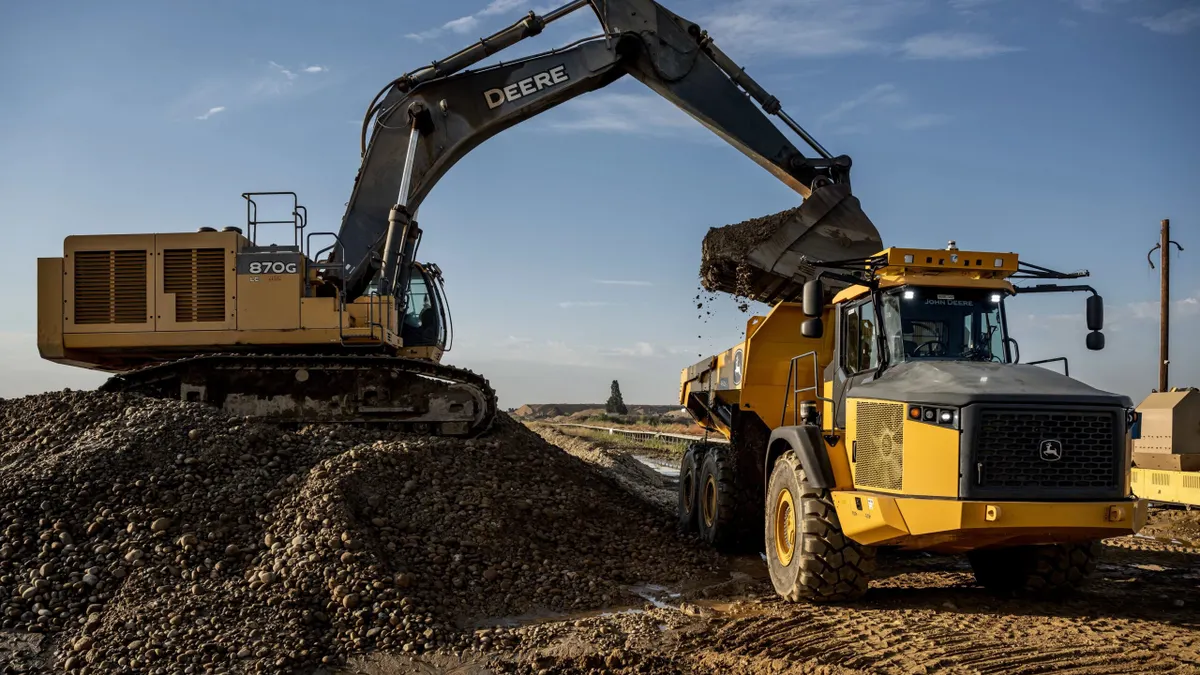
- Deere expects to have “slightly higher” revenue during the third and fourth quarters over the first half of the year, CFO Brent Norwood said on a recent earnings call. He cited increased spending on construction and road-building equipment for data center buildouts and other large projects.
Dive Insight:
While tractors and agricultural equipment are what Deere is known for, the company has slowed production over the years and focused on destocking new equipment to account for slower demand as farmers get squeezed by higher production costs and income declines.
“Customer sentiment remains muted despite recent grain price increases,” Christopher Seibert, Deere’s director of investor relations, said on the call. As farmers navigate volatile input costs and high interest rates, Deere has focused on positioning itself for when the agriculture cycle begins to rebound.
In addition to managing new inventory levels, Seibert said Deere has continued to improve its used inventory and introduce technology solutions, such as autonomous sprayers and fertilizer applicators.
For the production and precision agriculture segment, Deere generated $4.5 billion in sales during the second quarter, a 14% decline over last year due to lower shipment volumes as the company faced higher production costs. Operating profit was $706 million, down 39% from a year ago.
At the same time, Deere’s other segments — small agriculture and turf and construction and forestry — saw double-digit sales and profit growth during the period driven by higher shipment volumes and favorable pricing.
“The diversification of our business segments, evidenced in 2026, with all three operating at different points in the cycle, provides increased resilience and enhanced growth opportunities for the organization,” Seibert said.
Looking ahead, Deere is expecting production and precision agriculture sales to decline 5% to 10% for the full year, citing elevated input costs and ongoing global market uncertainty. Meanwhile, the company is tracking its small ag and turf and construction and forestry segments to increase 15% and 20%, respectively, over last year.
“Construction demand remains robust, supported by infrastructure spending, rental activity and accelerating data center investments,” Norwood said.
In the U.S. and Canada, Deere’s order book increased more than 60% since November for its construction and forestry segment, and is at its highest level since April 2024, he said.
“Data center construction is expected to top $100 billion in 2026, with additional double-digit growth into 2027,” Norwood said. Deere is also seeing a boost from infrastructure projects funded by the Infrastructure Investment and Jobs Act, as well as oil and gas, warehousing and road building, he added.
During the second quarter, Deere recorded a $272 million recovery from claims related to the International Emergency Economic Powers Act tariffs, which were ruled unlawful earlier this year. Josh Beal, Deere’s director of investor relations, said this lifted the company’s margins by 2.5 points.
Following the Supreme Court’s ruling to invalidate the Trump administration’s IEEPA tariffs, new Section 122 tariffs and adjustments to Section 232 tariffs came online. Beal said the total impact of these changes makes Deere’s direct tariff exposure “essentially unchanged” for the year at $1.2 billion, representing a 3% margin headwind.
Including the refund, Beal said Deere expects tariff costs to total $900 million for the year.
The estimates do not factor in President Donald Trump’s latest proclamation on Monday that cuts tariffs on agricultural equipment from 25% to 15%, and adjusts tariffs on construction equipment, such as bulldozers and forklifts, to 15% when imported from trade deal countries.