U.S. chipmakers offered calculated support for the Trump administration’s plan to implement a 25% tariff on certain advanced semiconductors, even as they navigate higher costs while trade negotiations continue.
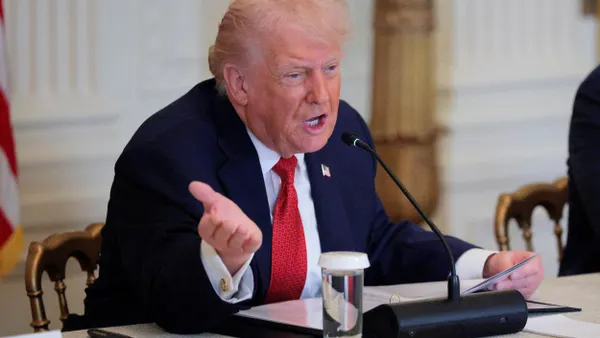
The tariff, imposed against artificial intelligence chips such as Nvidia’s H200 and AMD’s MI325X, will not affect materials that are imported to support expansion of U.S. semiconductor supply chain and manufacturing capacity, according to the White House. President Donald Trump may impose broader tariffs on semiconductors and products containing them in the near future. The AI chip tariff became effective Jan. 15.
Manufacturing Dive requested comments from a dozen U.S. and international semiconductor companies about the tariff and how they are navigating it. The majority declined or ignored requests for comment.
An Nvidia spokesperson sent an email applauding the president’s decision to support high-paying jobs and manufacturing in the U.S.
“Offering H200 to approved commercial customers, vetted by the Department of Commerce, strikes a thoughtful balance that is great for America,” the Nvidia spokesperson said.
Taiwan Semiconductor Manufacturing Co., the world’s largest chipmaker, and Intel both declined to comment. The U.S. government on Thursday struck a deal with Taiwan, including TSMC, to invest $250 billion in American semiconductor production in exchange for lower tariffs. It also has a 10% stake in Intel valued at $8.9 billion, which President Donald Trump recently touted on Truth Social.
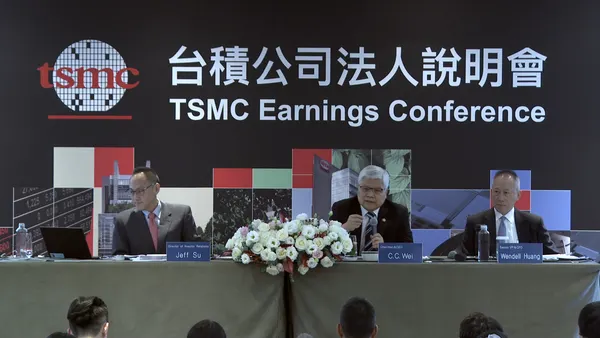
After the trade agreement was made, CFO Wendell Huang told Bloomberg Television that TSMC will continue to grow in the U.S. due to increased customer demand and try to accelerate the transition its semiconductor expertise stateside, but its “leading-edge” technologies and operations will remain in Taiwan.
Other reactions
Global industry association SEMI overall supported the administration’s effort to strengthen U.S. semiconductor production, saying the approach was consistent with the organization’s political advocacy.
Currently, billions of dollars are going toward domestic chipmaking. However, at this point the U.S. is still strongly reliant on foreign suppliers. According to the White House, the nation uses about 25% of the world’s semiconductors and can only make 10% of the chips it requires.
“SEMI urges the Administration to continue engaging closely with industry to ensure any further trade actions account for commercial and operational realities, and minimize unintended impacts on global supply chains,” the organization said in a statement. It noted that a number of international segments cannot be “easily replicated or relocated” quickly enough to support a U.S. buildout.
South Korea, home to major chipmakers Samsung and SK Hynix, is seeking favorable trade terms with the U.S. after Trade Minister Yeo Han-Koo said over the weekend that the new tariff would have a “limited impact” on the country’s companies, Reuters reported.
Many domestic fab projects are underway by the likes of Intel, Micron and TSMC, with many still years away from opening. One of the biggest challenges for chipmakers is that building advanced semiconductor fabrication plants takes a lot of time and capital. Until that manufacturing is moved to the U.S. or the tariffs are reversed, companies that rely on foreign chips for electronics are going to deal with increased prices, said Jack Gold, founder and principal analyst at research firm J. Gold Associates.
“When markets are this unstable, how do you know how to set a strategy for your products?” Gold said. “From a purely manufacturing perspective, there’s a lot of uncertainty in trying to put together a business plan, and that’s not a good thing for companies, and it slows investment, and it causes all kinds of weird stuff going on.”